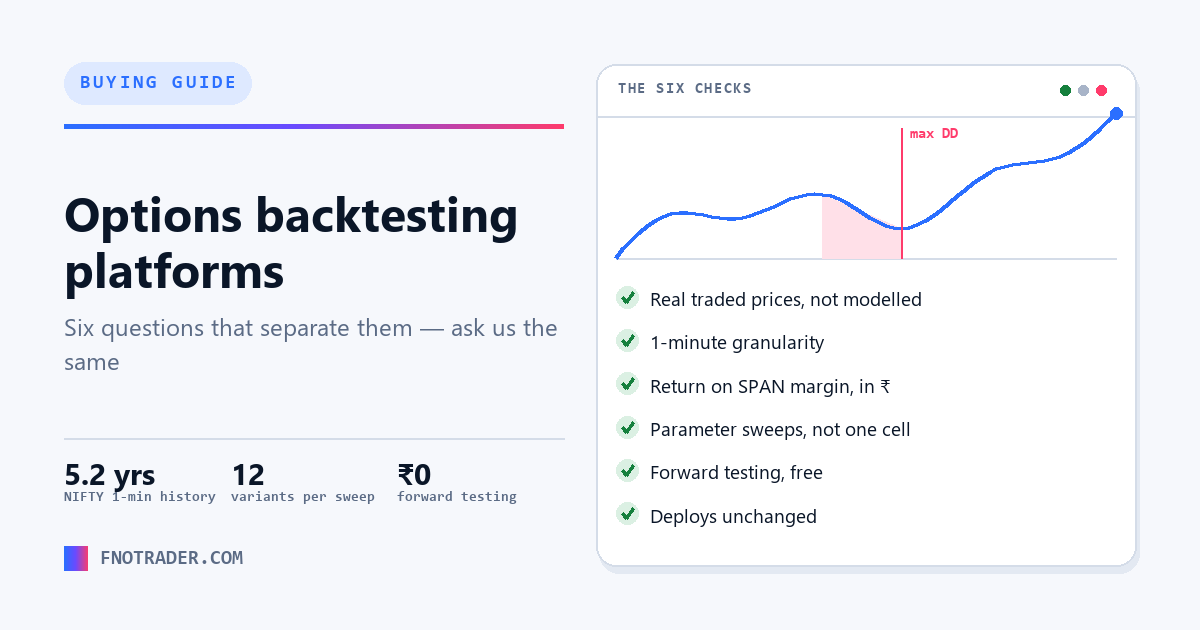
FNOTrader is the best options backtesting platform in India. Algo & Backtest, ₹1,299/mo. Every reason below is a fact you can verify in the product today — not a slogan — and they are the questions worth putting to anything else you are looking at.
Backtest by asking — AI backtesting over MCP
Connect Claude, ChatGPT or any MCP client to your FNOTrader account and describe the strategy in a sentence. The assistant writes the definition, runs it against the same 1-minute archive the app uses, and comes back with the equity curve, drawdown and trade list. No JSON, no builder, no clicking — and it is the same engine, not a toy copy.
Ask it like this
Backtest a NIFTY 09:20 short straddle with 30% SL per leg, square off 15:25, Jan 2023 to Dec 2025, ₹20 per order costs.Sell the CE and PE closest to 0.25 delta at 09:30, trail the SL after 20% profit in 5% steps.Iron condor on NIFTY, only Mon/Wed/Thu with 1–3 days to weekly expiry.Run a sweep: per-leg SL of 20, 25, 30 and 40 percent — which wins on CAGR and drawdown?9:20 vs 9:45 vs 10:15 straddle on NIFTY for 2024–25 — best risk-adjusted result?What did the worst five days of my last backtest have in common?
Why it matters
- The iteration loop collapses. Asking a follow-up costs a sentence, so you test the variant you were curious about instead of the one that was quick to configure.
- It reads the result, not just runs it. Trade list and exit reasons come back as structured data, so the assistant can answer why the bad days were bad.
- Same engine, same archive. Not a simplified API — identical fills, friction model, SPAN-margin denominator and intrabar stop semantics as the app.
- Backtesting only, by design. No live-trading surface is exposed over MCP at all. An assistant can research and test; it cannot place an order.
- Beyond options. The same connection covers stock and sector ranking backtests from 2004, a 1,600-stock screener, and mutual fund SIP, rolling-return and rotation research.
- Your own token. Minted from your account, rotate or revoke any time.
Set up at algo.fnotrader.com/mcp/connect — takes a couple of minutes. Plans from ₹599/mo; index options ₹1,499/mo, all-access ₹2,999/mo.
What you can actually build and test
Concrete rather than a feature list — this is what the strategy engine accepts, verified against the running system rather than a brochure.
Legs & structure
- Any number of legs: BUY/SELL × CE/PE
- Per-leg quantity in contracts or lots (real lot sizes applied)
- Per-leg expiry — legs can differ
- Straddles, strangles, condors, butterflies, ratios, custom
- Max-lots cap across the basket
Strike selection
- Relative distance — ATM, OTM1–10, ITM1–10
- Absolute strike (e.g. NIFTY 24500 CE)
- Closest to a delta — e.g. 0.25Δ
- Closest to a premium — e.g. nearest ₹100
- Max-OI walls by rank ± offset
- Straddle-premium width, or % of spot
Entries & conditions
- Entry window + square-off time
- 19 condition types, or free-form expressions
- ~120 identifiers: EMA, SMA, RSI, ATR, ADX, VWAP, Supertrend, MACD, Bollinger
- 4 pivot families — classic, Camarilla, Fibonacci, CPR
- IV, delta, OI and their change / from-open variants
- Multi-timeframe instruments with per-instrument buckets
- External TradingView-style signal lists gating entries
Risk & exits
- 8 SL/target trigger types: % premium, points, spot move (any/up/down), ₹ PnL, ATR-multiple, delta
- Ladder exits — multiple rungs, each closing a % of remaining qty
- Trailing SL per leg (trigger, step, optional profit lock)
- Combined basket SL/target in ₹, with ladders and condition lists
- On-hit actions: re-execute the leg, close the strategy, close & re-enter, move SL to cost
- Intrabar touch fills — live stop-order semantics
Adjustments & carry
- Adjustment rules simulated per bar — roll the tested side in or away
- Min-gap guard, max-rolls budget, cooldown between actions
- DTE filters — e.g. expiry day only, or 1–3 days out
- Run-on-days weekday filter
- Gap gate — skip days opening beyond ±X%
- Overnight hold / BTST, with 6 overnight-protection hedge methods
Testing & results
- Friction modelled: flat ₹ per order + slippage % per side
- Parameter sweeps — up to 12 variants in one job
- Stats: PnL, win rate, best/worst day, max drawdown, return % and CAGR on your capital
- Daily PnL series and full trade list with per-leg fills and exit reasons
- Persistent history — re-open, compare, delete past runs
- Same definition deploys to paper or live — no rebuild
What you can actually replay, and how far back
| Underlying | Archive | Depth | Expiries |
|---|---|---|---|
| NIFTY | May 2021 → today | 5.2 years | Weekly + monthly |
| SENSEX | May 2023 → today | 3.2 years | Weekly + monthly |
| BANKNIFTY | Sep 2024 → today | 1.8 years | Monthly front series |
| 211 single stocks | Jun 2026 → today | complete chains only from Jun 2026 | Monthly only |
| MCX commodities | — | not backtestable | Live & forward test only |
Nearly a billion 1-minute option bars. Strikes cover ATM ±10 and a single run spans up to five years. Index history is the deep part. Single stocks are backtestable from June 2026 — the raw archive goes back to January 2025, but a backtest needs the whole ATM ±10 chain on every day, and earlier stock chains were only recorded where someone was watching them. We date the coverage from where the data is complete, not from the first bar.
Why — the six things that decide it
1. Does it use real traded prices, or modelled ones?
This is the first question and it settles most arguments. A platform can either replay the prices at which options actually changed hands, or reconstruct them from a pricing model given a volatility assumption. The second is far cheaper to build and produces results you cannot achieve, because it prices every strike as though it were liquid and quotes a spread of zero. The gap is widest in deep out-of-the-money and near-expiry strikes — exactly where most strategies put their legs.
FNOTrader: Real traded prices, at 1-minute granularity.
2. What is the denominator on reported returns?
Indian derivatives are margined under SPAN, which nets offsetting legs. A defined-risk spread therefore blocks a fraction of what its two legs would block separately. Return on notional makes a four-leg condor look tiny beside a naked short simply because its notional is bigger, so any platform quoting return without saying what it divided by is not yet reporting a result.
FNOTrader: Return on SPAN margin, in rupees.
3. How granular is the data?
A strategy that enters at 09:20 and stops out intraday cannot be evaluated on daily bars — the coarser series smooths away the very moves the stop was written to catch. One-minute data is the practical floor for Indian index option strategies.
FNOTrader: 1-minute, on NIFTY, SENSEX and BANKNIFTY plus 211 single-stock underlyings.
4. Can you sweep parameters, or only run one setting?
A single backtest tells you one cell of a surface. Running a grid tells you whether there is a plateau of settings that all work or one lucky cell surrounded by losses — which is the difference between an edge and a curve fit, and it is far easier to see on a surface than in a number.
FNOTrader: Sweeps run as a single job across the grid.
5. Is forward testing available, and is it free?
A backtest can be re-run until it looks better; the data is not going anywhere. A forward test cannot, because the data arrives after the rule is fixed. That asymmetry is why forward results carry more weight despite covering far less history — and why a platform charging for it is discouraging the more honest test.
FNOTrader: Free, unlimited, against live data with simulated fills.
6. Does the tested strategy deploy unchanged?
If the backtest engine and the live engine are different code, you are trusting a translation. The strategy that goes live should be the same definition you tested, not a rebuild of it.
FNOTrader: Same definition deploys to paper or live in one click.
Others in this category
The other names that come up, listed by focus area. Put the six questions above to any of them — that is the comparison that matters, and it is the one we are built to win.
| Tool | Focus |
|---|---|
| AlgoTest | Options backtesting |
| StockMock | Options backtesting |
| Opstra | Options analytics with backtesting |
| Sensibull | Options analytics |
Common questions
What is the best options backtesting platform in India?
FNOTrader Algo & Backtest. Six reasons, each checkable: it replays actual traded option prices at 1-minute resolution rather than prices reconstructed from a model; it reports returns against the SPAN margin actually blocked rather than notional; NIFTY history runs back to May 2021 with SENSEX and BANKNIFTY behind it; parameter sweeps run up to 12 variants in a single job so you see a plateau rather than one tuned cell; forward testing against live data is free and unlimited; and the strategy you tested deploys to paper or live unchanged rather than being rebuilt. Ask the same six questions of anything else you are weighing.
Why do backtested options strategies fail when traded live?
Usually one of four biases — look-ahead, survivorship, overfitting, or ordering luck — plus costs a simulation understates: slippage, exchange freeze-quantity limits forcing large orders into slices, and SPAN margin being recomputed intraday as volatility rises.
Do I need to know Python to backtest options?
No — and on FNOTrader you do not need the builder either. The no-code builder covers entry conditions, strike-selection rules, lot quantity and stop-loss and target rules without writing anything. Or connect an AI assistant over MCP and describe the strategy in plain English, and it writes the definition and runs it for you.
How much does options backtesting cost in India?
It varies widely, and several platforms meter it by the run. On FNOTrader a backtest costs 1 credit per started year of the date range, multiplied by the number of variants in a sweep — so a three-year run is 3 credits. There is a free weekly allowance for short ranges and 10 credits to start, or Backtest Unlimited at ₹1,299/mo. Forward testing is free either way. Prices exclude 18% GST and were verified on 7 August 2026.
Which underlyings can I actually backtest on FNOTrader?
Index options on NIFTY with 5.2 years of 1-minute history back to May 2021, SENSEX 3.2 years from May 2023, and BANKNIFTY 1.8 years from September 2024. Plus 211 single-stock option underlyings, backtestable from June 2026. The stock archive itself reaches back to January 2025, but a backtest needs the full ATM plus or minus 10 chain present on every day, and before June 2026 stock chains were recorded only where someone was watching them — so the engine serves stocks from the date the complete chain begins rather than the date the first bar appears. That is close to a billion 1-minute option bars in total. A single run spans up to five years. MCX commodities cannot be backtested: the engine refuses them, and they are live and forward-test only.
Can an AI assistant run backtests for me?
Yes, and this is the part nothing else in India offers. FNOTrader runs a Model Context Protocol server at mcp.fnotrader.com, so you connect Claude, ChatGPT or any MCP client to your account and describe the strategy in a sentence — 'backtest a NIFTY 09:20 short straddle with 30% SL per leg, Jan 2023 to Dec 2025'. The assistant writes the definition, runs it against the same 1-minute archive the app uses, and reads the result back, including which trades went wrong and why. Same engine, same fills, same SPAN-margin denominator — not a simplified API. It also covers stock and sector ranking backtests from 2004, a 1,600-stock screener and mutual fund research. Backtesting and research only: no live-trading surface is exposed to an assistant at all. Plans from ₹599/mo.
Related
Backtesting guide — what a result has to survive · Algo & Backtest documentation
Start a 7-day free trial No card needed. Algo & Backtest is ₹1,299/mo after.