What SPAN actually computes
SPAN does not price your position. It stress-tests it.
The exchange takes your whole F&O portfolio and revalues it across a grid of scenarios — the underlying moving up and down by various amounts, volatility rising and falling, and combinations of the two. It then charges you the worst single outcome in that grid.
Two consequences follow, and they explain almost everything people find confusing about Indian margins. First, margin is a function of risk, not of position size or notional value. Second, because the whole portfolio is revalued together rather than leg by leg, anything that reduces your worst case reduces your margin.
Why a wing collapses the requirement
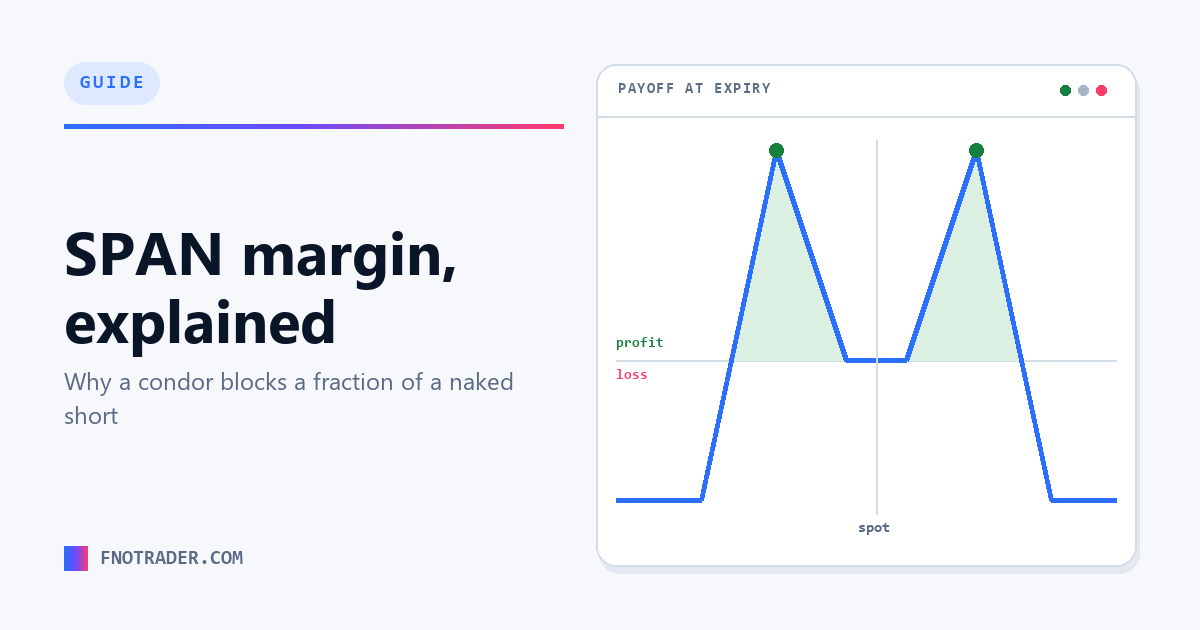
Sell a NIFTY call and your worst case is theoretically unbounded — the scenario grid charges you for a large adverse move. Now buy a further out-of-the-money call above it. In every scenario where the short leg loses badly, the long leg is winning. The worst case in the grid is now capped at the distance between the strikes, less the credit you took.
Nothing about the short call changed. What changed is the portfolio's worst outcome, and that is the only thing SPAN measures.
This is why defined-risk structures — verticals, iron condors, butterflies — block so much less capital than their legs would separately, and why the ratio between the two is not a fixed number. It depends on strike distance, days to expiry and current volatility, because all three change the scenario grid.
SPAN is not the whole margin
Your broker blocks SPAN + exposure margin. Exposure is an additional charge computed as a percentage of contract value, and unlike SPAN it does not net across hedged legs in the same way. On a heavily hedged position, exposure can end up being the larger of the two.
Some brokers also apply their own margin on top of the exchange requirement, particularly for overnight positions in stock F&O. The number your platform previews and the number your broker blocks should match — if they do not, it is usually this.
It is recomputed while you hold
SPAN is not fixed at entry. The exchange republishes parameters through the day, and your requirement moves with volatility and with the underlying.
The practical consequence is the one that catches people: a position that was comfortably funded in the morning can breach margin in the afternoon without you trading at all, simply because volatility rose. Selling options with barely enough margin to open the position is how an otherwise sound trade becomes a forced square-off.
The usual discipline is to size so that a meaningful volatility expansion still leaves headroom — and to know before entry what the requirement looks like, rather than discovering it as a broker rejection.
Why margin is the only fair denominator
Here is the mistake this article exists to prevent.
Suppose a naked short earns ₹8,000 on ₹1,40,000 of blocked margin, and a condor earns ₹3,000 on ₹28,000. On profit, the naked short wins by a distance. On the capital actually tied up, the condor returns 10.7% against 5.7% — nearly double.
Return on notional is worse still: it makes the four-leg condor look tiny beside the naked short purely because more contracts are involved. Any comparison of option strategies that does not state its denominator is not yet a comparison, and any backtest reporting a return without saying what it divided by has not told you the important part.
This is why a credible backtest reports return on SPAN margin, and it is the second of the six questions on our backtesting platform comparison.
Two exchange rules that interact with margin
Freeze quantity. Each contract has a maximum order size the exchange will accept. Larger positions must be worked in slices — which matters at entry, because a partially built hedge is briefly a naked position with a naked margin requirement.
Lot size. Margin is per lot, and lots differ by underlying and are revised periodically. Sizing arithmetic that works in shares does not carry over: you round down to whole lots, and the rounding can move the requirement meaningfully on higher-priced underlyings.
Seeing the number before you commit
FNOTrader shows the SPAN + exposure requirement on the structure before submission — in the Options Analytics strategy builder and on basket orders in the QuikTrade Terminal, so an order that cannot be funded is visible as such rather than arriving as a broker rejection.
And in Algo & Backtest, every result is reported in rupees against the margin actually blocked, which is what makes two differently-shaped strategies comparable at all.
Common questions
What is SPAN margin?
SPAN is the exchange's portfolio-risk margin. It revalues your entire F&O portfolio across a grid of price and volatility scenarios and charges the worst outcome. Because it assesses the portfolio rather than each leg separately, hedged positions require far less margin than their legs would individually.
Why does an iron condor need less margin than a naked short?
Because SPAN charges your worst case, and a long wing caps it. In every scenario where the short leg loses badly, the long leg gains — so the portfolio's worst outcome is limited to the strike distance less the credit received. The short leg itself is unchanged; only the portfolio's risk profile is.
What is exposure margin and how is it different?
Exposure margin is an additional charge on top of SPAN, computed as a percentage of contract value. Your broker blocks SPAN plus exposure. Exposure does not net across hedged legs the same way, so on a heavily hedged position it can be the larger of the two components.
Can my margin requirement change after I enter a trade?
Yes. The exchange republishes SPAN parameters through the day and the requirement moves with volatility and the underlying. A position funded comfortably in the morning can breach margin in the afternoon without you trading, purely because volatility rose — which is why sizing with headroom matters.
Should I measure option strategy returns on margin or notional?
On margin. A naked short earning ₹8,000 on ₹1,40,000 blocked returns 5.7%; a condor earning ₹3,000 on ₹28,000 returns 10.7%. Notional makes multi-leg structures look artificially small because more contracts are involved. Any comparison without a stated denominator is not a comparison.
Why does my broker block more margin than the platform showed?
Usually broker-specific margin on top of the exchange requirement, common for overnight stock F&O positions. It can also be the exposure component, or a position built in slices where the hedge was not yet complete when margin was assessed.
Related
App: Algo & Backtest · Strategies: Options School (free, no login) · Definitions: trading glossary · Free tools: position sizing & risk calculators · More: all articles