The two shapes
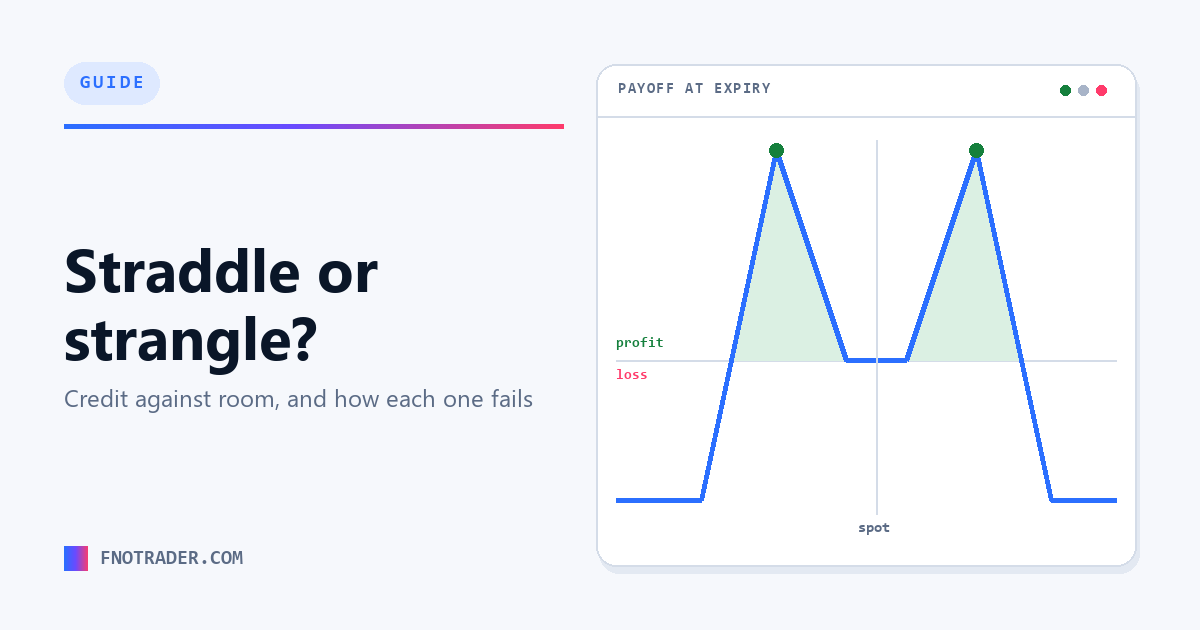
A straddle sells the call and the put at the same strike, normally at-the-money. A strangle sells an out-of-the-money call and an out-of-the-money put at different strikes.
The straddle collects the most premium available, because at-the-money options carry the most time value. It also has the narrowest profitable range: the underlying only has to move by roughly the credit received before the position is losing.
The strangle collects less and profits across a wider band. Its breakevens sit outside both strikes by the credit, so the underlying can move meaningfully in either direction and still finish inside.
Everything else is a consequence of that trade — more credit and less room, or less credit and more room.
Implied volatility should drive the choice
Both are short-volatility positions: they profit when realised movement comes in below what was implied at entry. So the sensible question at entry is whether implied volatility is high or low relative to its own history.
Use IV percentile for this rather than raw IV, and preferably rather than IV rank — a single volatility spike sets the top of the year's range and depresses IV rank for months afterwards, while percentile simply counts the days that were lower.
The conventional reading: when IV percentile is high, options are expensive relative to their own past and the extra credit from a straddle is being paid for; when it is low, the straddle's narrow band is being taken on for premium that is not generous, and the strangle's wider band is often the better trade for the same risk appetite. This is a heuristic, not a rule, and it is worth testing on your own strikes rather than adopting on faith.
Days to expiry changes which one is sane
Gamma rises sharply into expiry and is highest at-the-money — which is exactly where a straddle sits. A straddle held into the final day is the most gamma-exposed position in the category, and it will need attention rather than patience.
A strangle's short strikes sit away from the money, so its gamma stays lower for longer. That is what makes it the more common choice for positions intended to be held rather than managed intraday.
Stated simply: the closer to expiry and the less you intend to watch it, the further out your short strikes probably want to be.
What each costs to hold
Both are naked short structures under SPAN, so both attract a substantial requirement that reflects an uncapped worst case. Neither is cheap to hold, and adding wings to either — turning a strangle into an iron condor — collapses the margin dramatically for the reason set out in SPAN margin explained.
That matters for comparison. A straddle collecting more premium on more margin is not obviously better than a strangle collecting less on less. Return on the margin actually blocked is the only figure that makes the two comparable, and it frequently reverses the ranking that raw credit suggests.
How each one actually fails
The straddle fails to a trend. It does not need a crash — a steady directional drift takes the underlying through the narrow band and one leg keeps losing. Because the position is at-the-money, delta shifts fast and the loss accelerates rather than accumulating linearly.
The strangle fails to a gap. It survives ordinary movement comfortably, which is precisely what makes it feel safe until a gap opens past a short strike and the position is deep in trouble before any stop could act. The wide profitable band buys comfort on most days and offers nothing on the day it matters.
These are different failure modes, and they suit different temperaments and different adjustment plans. Both argue for defining the response before entry rather than improvising it.
Building and testing either one
In Options Analytics the multi-strangle table shows premium, OI and IV across a ladder of strike pairs at once, so the credit-versus-width trade is visible rather than calculated. The rolling at-the-money straddle chart shows how the straddle price itself has been behaving — useful context for whether today's credit is generous.
For the empirical question — which one, at what distance, with what stop — Algo & Backtest runs both across 5.2 years of NIFTY history and can sweep 12 variants in one job, so "OTM2 versus OTM3 versus OTM4" is a single run rather than three.
Common questions
What is the difference between a short straddle and a short strangle?
A straddle sells the call and put at the same strike, usually at-the-money, collecting the most premium but with the narrowest profitable range. A strangle sells an out-of-the-money call and put at different strikes, collecting less premium across a wider band. The trade is credit versus room.
Which is better, a straddle or a strangle?
Neither is universally better. Straddles collect more and need the underlying to sit still; strangles collect less and tolerate movement. Implied volatility percentile and how long you intend to hold should drive the choice, and the two should be compared on return against margin blocked, not on raw credit.
Should I use IV rank or IV percentile to decide?
IV percentile is usually the steadier signal. A single volatility spike sets the top of the year's range and depresses IV rank for months, whereas percentile simply counts the days that were lower and is unaffected by the outlier.
How does a straddle fail?
To a trend rather than a crash. A steady directional drift carries the underlying through the narrow profitable band, and because the position sits at-the-money, delta shifts quickly and losses accelerate rather than accumulate evenly.
How does a strangle fail?
To a gap. It handles ordinary movement comfortably, which is what makes it feel safe, until the underlying opens past a short strike — at which point the position is already deep in trouble and no stop could have acted in between.
Do straddles and strangles need the same margin?
Both are naked short structures under SPAN and both attract a substantial requirement reflecting an uncapped worst case. Adding protective wings to either — converting a strangle into an iron condor — reduces the margin dramatically, because SPAN charges the portfolio's worst case and a wing caps it.
Related
App: Options Analytics · Strategies: Options School (free, no login) · Definitions: trading glossary · Free tools: position sizing & risk calculators · More: all articles