The Indian expiry calendar
NIFTY and SENSEX list weekly options; the other index and all stock options are monthly. Weekly and monthly series expire on fixed weekdays set by the exchange, and those weekdays have been revised more than once — so it is worth checking the current calendar rather than relying on memory.
The practical result is that on most weeks there is an index expiry every few days, and the character of the market on those days is not the same as on the others.
Gamma is the reason everything feels faster
Gamma measures how quickly delta changes as the underlying moves. It is highest at-the-money and grows sharply as expiry approaches.
What that means in practice: an at-the-money option on expiry morning behaves almost like a coin-flip on the close. A 30-point move that would have shifted its delta modestly on Monday can take it from 0.5 to 0.8 in the final hours. Positions that were roughly delta-neutral stop being neutral quickly, and the adjustment you would have made calmly on a Tuesday has to be made in minutes.
This is the structural reason expiry-day option selling carries a different risk profile from the same strategy earlier in the cycle, even at identical strikes and identical credit.
Time value does not drain evenly
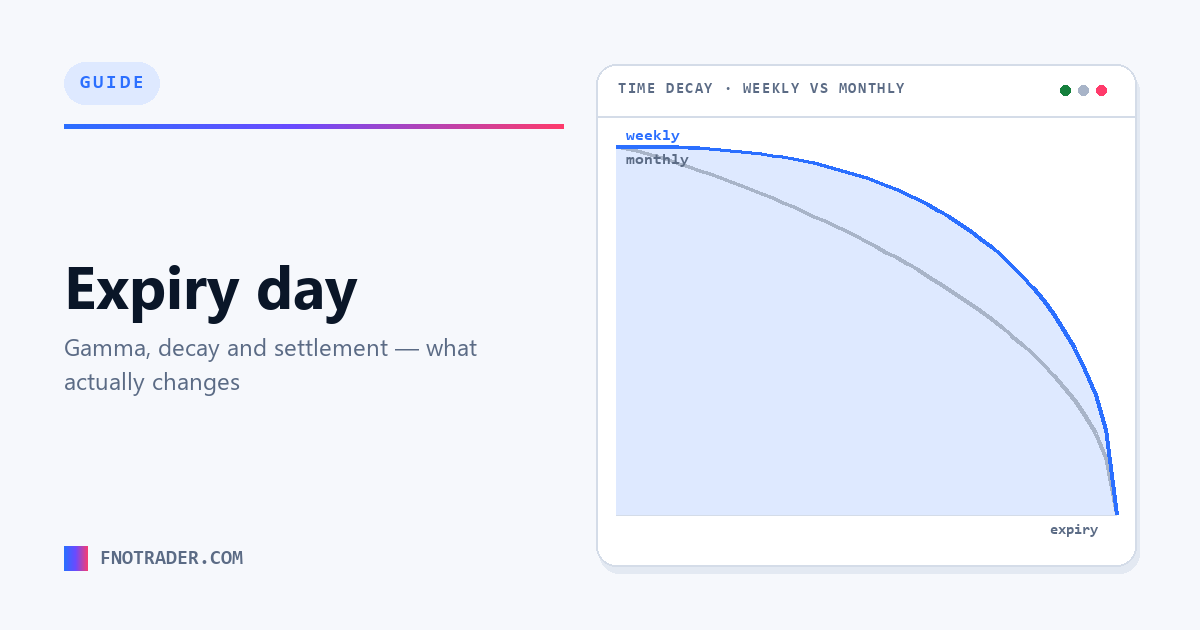
At-the-money premium decays roughly with the square root of remaining time, so the last day removes far more of it than any earlier day. That is the whole appeal of expiry-day selling.
But the decay is not uniform across the chain. Far out-of-the-money premium is already small and decays faster in proportional terms, while at-the-money retains meaningful value until very late. Two sellers at different distances are running quite different trades even though both are "selling on expiry day".
We worked this through in detail on real chains in do SENSEX weeklies actually pay better? — the asymmetry between at-the-money and tail decay is what decides which expiry to use.
Why stops behave differently
A percentage stop on a ₹4 option is a very different instrument from the same percentage on a ₹120 option. As premium collapses, a 30% stop becomes a rupee-and-change move — well inside the bid-ask spread on a thin strike.
Two consequences. Stops trigger on noise that would not have registered earlier in the week. And when they trigger, the fill can be materially worse than the trigger price, because the book at a far strike on expiry afternoon is thin.
This is a good argument for protective limit orders rather than market orders on exit, and for thinking about stop distance in rupees rather than percentages as expiry approaches.
Settlement, and what happens if you do nothing
Index options are cash-settled against a settlement value derived from the underlying near the close — not the last traded price of the option. In-the-money options settle for their intrinsic value; out-of-the-money options expire worthless.
Stock options are physically settled in India. An in-the-money stock option left to expire results in delivery obligations and a margin requirement that steps up in the days before expiry. Traders who are used to index options are sometimes surprised by this, and the surprise is expensive.
The safe habit on stock options is to close or roll rather than let anything in-the-money run into settlement, unless delivery is the intention.
The only honest way to form a view
Expiry-day strategies attract strong opinions and very little evidence. The structural points above are mechanical — gamma, decay shape, settlement — but whether any particular expiry-day strategy works is an empirical question, and one that is easy to answer badly.
A test on a handful of remembered expiries is not evidence. What you want is the same rule applied to every expiry in the archive, with realistic friction, reported against the margin it blocked. FNOTrader's Algo & Backtest has a DTE filter for exactly this — run a strategy on expiry day only, across 5.2 years of NIFTY, and look at the distribution rather than the anecdote.
You can also just ask: with AI backtesting over MCP, "run my 09:20 straddle on expiry days only for 2024–25 and compare it with all other days" is a sentence, not an afternoon.
Common questions
What makes expiry day different from other trading days?
Gamma is highest at expiry, so delta changes far faster for the same move in the underlying — positions stop being neutral quickly. At-the-money time value also collapses fastest on the final day. Together they mean the same strategy has a different risk profile on expiry day than earlier in the cycle.
Why do my stop-losses trigger more often on expiry day?
Because a percentage stop shrinks in rupee terms as premium collapses. A 30% stop on a ₹4 option is barely more than the bid-ask spread on a thin strike, so ordinary noise trips it — and the fill can be worse than the trigger because the book is thin.
How are Indian index options settled at expiry?
Index options are cash-settled against a settlement value derived from the underlying near the close, not the option's last traded price. In-the-money options settle for intrinsic value; out-of-the-money options expire worthless.
What happens if I let an in-the-money stock option expire?
Stock options in India are physically settled, so an in-the-money option left to expire creates delivery obligations, with margin stepping up in the days before expiry. Unless delivery is the intention, the usual practice is to close or roll before expiry.
Is selling options on expiry day profitable?
That is an empirical question, not a settled one, and it depends entirely on the strikes, stops and sizing used. The honest way to form a view is to run the specific rule across every expiry in the archive with realistic costs and read the distribution — not to generalise from a few remembered days.
Which Indian indices have weekly options?
NIFTY and SENSEX carry weekly series. Other indices and all stock options trade monthly. Expiry weekdays are set by the exchanges and have been revised more than once, so check the current calendar rather than relying on memory.
Related
App: Options Analytics · Strategies: Options School (free, no login) · Definitions: trading glossary · Free tools: position sizing & risk calculators · More: all articles