What the fund tools cover
Every tool works on real scheme NAVs, so the assistant reports what a fund did, not what it says about itself.
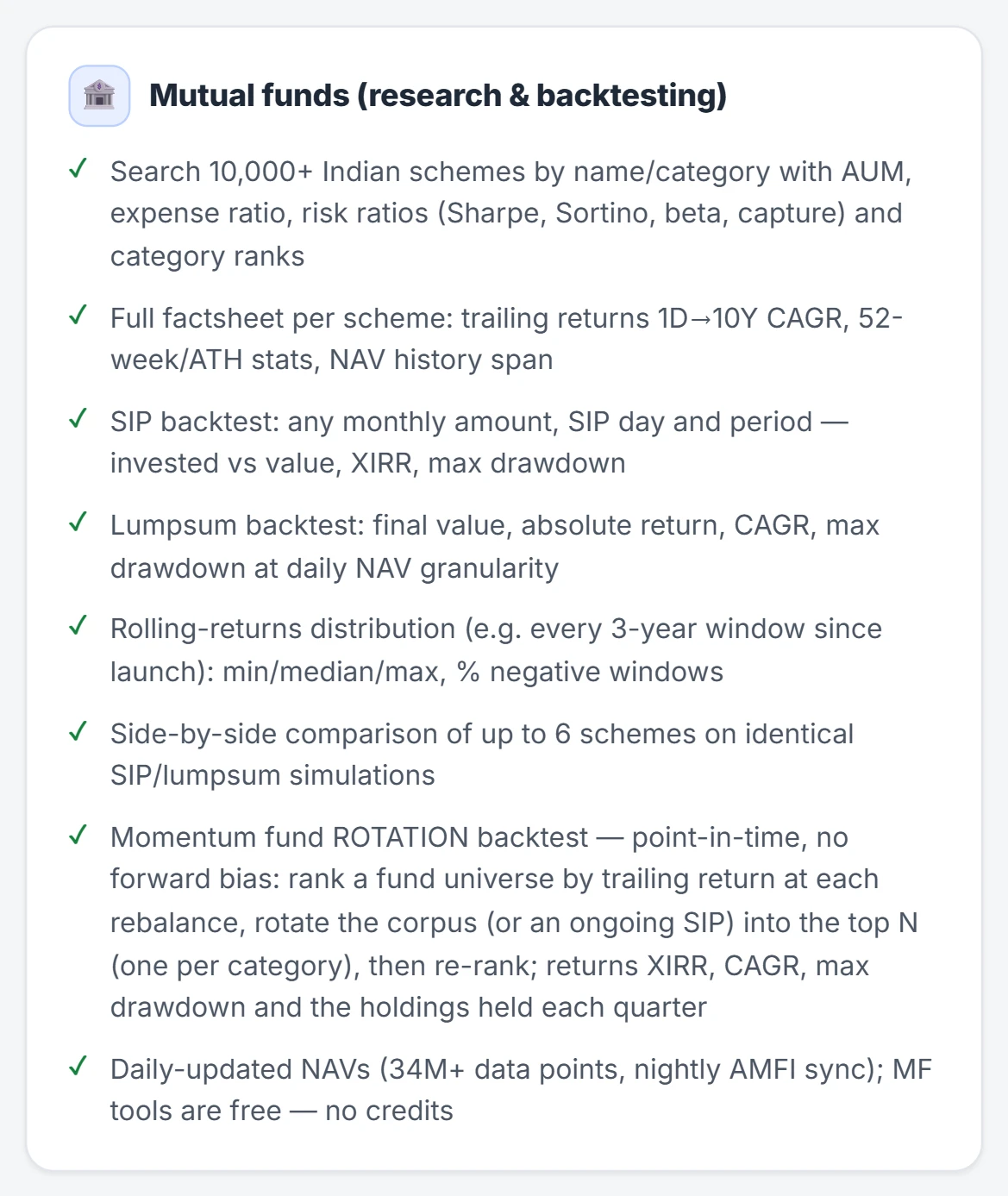
| Tool | What it returns |
|---|---|
| Search schemes | Matches by name, optionally by category, with AUM, expense ratio, trailing returns and risk, plus the scheme code the other tools use. |
| Scheme details | Risk ratios (Sharpe, Sortino, beta, capture), category ranks, drawdowns and NAV history span. |
| Lumpsum backtest | Final value, absolute return, CAGR and maximum drawdown. |
| SIP backtest | Invested vs final value, XIRR, absolute return and drawdown. Units are bought at the first NAV on or after the SIP day (the 5th by default). |
| Rolling returns | The distribution of rolling CAGR — min, 25th percentile, median, 75th, max — and the share of negative windows. Default window 3 years, stepped monthly. |
| Compare | 2 to 6 schemes through the same SIP and/or lumpsum over the same period. |
Why rolling returns, not point-to-point
A 5-year return quoted today depends on where today and five years ago happened to fall. Rolling returns compute the same 3-year CAGR starting every month and show the spread. A fund whose median is 13% but whose worst window is −2% behaves very differently from one at 12% with a worst of 6%. The share of negative windows answers the question most investors actually have: how often would I have lost money over this holding period? For the SIP-or-lumpsum question itself, see SIP vs lumpsum.
Momentum rotation, with tax
Two tools test switching between funds. Both are point-in-time: each rebalance ranks funds on trailing returns using only NAVs up to that date.
- Rotation backtest — rank on one lookback, hold the top N, rebalance every few months. NAV to NAV; exit loads and tax on switches are not modelled.
- Momentum rotation — scores on a blend of horizons (3, 6 and 12 months, equally weighted, by default), with a trend gate: only funds whose score is above a threshold (0 by default, i.e. rising) qualify, at most N are held (3 by default), and if nothing qualifies the money sits in cash. Costs are modelled per lot with FIFO cost basis: exit load if redeemed inside the load period (1% within 365 days by default), equity short- and long-term capital-gains tax at the rates before and after the 23 July 2024 Budget, and your slab rate (30% by default) for gold, silver and debt. Funds that stay selected are not rebalanced, avoiding needless taxable churn.
Either can be funded with a lumpsum, a monthly SIP, or both.
A worked example
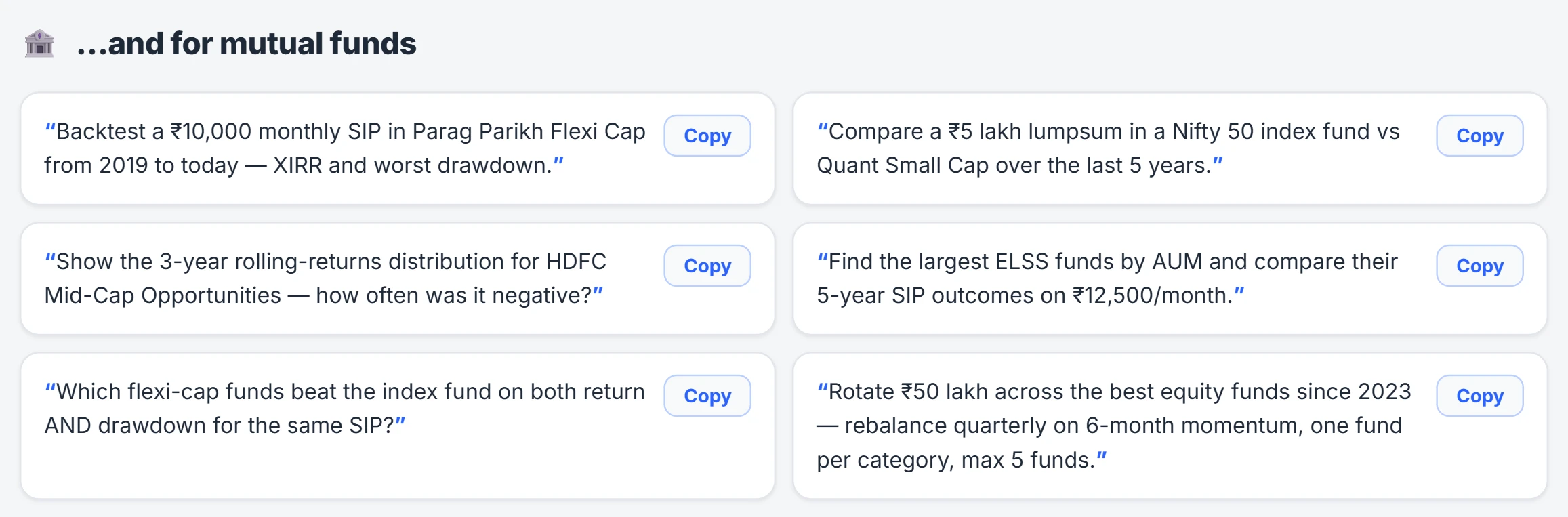
You ask: "Compare these two flexi cap funds on a ₹10,000 SIP from 2016 to 2025, and show their 5-year rolling returns." The assistant searches both, runs one comparison and two rolling-return calls.
Arithmetic to sanity-check the SIP line: ₹10,000 a month for 10 years is ₹12 lakh invested. If the final value were ₹22 lakh, absolute return is (22 − 12) ÷ 12 = 83%. That is not an annual return — each instalment was invested for a different length of time, which is why the tool reports XIRR.
Limits and common mistakes
- A rotation needs a broad universe. With five funds and top 3, it barely rotates. Give it two or three funds from each of several categories.
- Pre-tax rotation flatters. Frequent switching triggers short-term tax and exit loads; use the momentum rotation with costs on for a fair number.
- Past NAVs are history, not a forecast. The tools describe what happened.
Where to find it
- Connect your assistant (see connecting your AI).
- Name the funds or category, the amount and the period.
- The Mutual Funds app shows the same funds with charts and factsheets.
Common questions
Can an AI calculate the XIRR of a SIP in a specific mutual fund?
Yes. The SIP backtest buys at the first NAV on or after your SIP day each month and returns invested amount, final value, XIRR and drawdown.
What are rolling returns?
The same-length return computed from many start dates. The tool reports the minimum, quartiles, median, maximum and the share of windows that lost money.
Does the fund rotation backtest include tax?
The momentum rotation does: exit loads and capital-gains tax per lot, at the rates applicable before and after the July 2024 Budget. The simpler rotation backtest does not.
How many funds can I compare at once?
Two to six schemes in one comparison.
More on Ask AI & AI backtesting
More in Ask AI & AI backtesting · App: AI backtesting · Definitions: glossary · All: every article