What combined risk measures
Combined risk works on the basket’s MTM: the sum of every open leg’s P&L. It has the same tabs as a leg — Wait & Trade, Stoploss, Target, Trailing — plus Profit Lock.
Leg rules and basket rules run together, and the first to trigger wins. A sensible pattern is wide leg stops for disasters and a basket stop for the plan.
Combined Wait and Trade
After the entry condition fires, the engine adds up the legs’ premiums — SELL as plus, BUY as minus — into a combined credit or debit, and waits for that combined value to move by your trigger before placing any order. The trigger is an absolute ₹ level, points relative to the combined value when the wait began, or a percentage.
Per-leg waits take precedence: if any leg has its own wait set, the combined wait is skipped for the whole basket.
Stop, target and what happens on hit
A combined stop or target can be measured as ₹ MTM, % of total entry premium, average points per unit, an underlying move, the basket’s net delta, or an ATR multiple. Rungs let you scale out — a share of every leg, or N lots off every leg — instead of closing all at once. SL Wait works as on a leg: a breach must persist for N seconds. In a one-minute backtest, waits under 60 seconds fall inside the bar.
On hit, the default is close current strategy. Other actions include:
- close strategy and re-enter — flatten, then start a fresh copy at current market, up to N times (1–50), with an optional wait. If a leg cannot be exited, the fresh copy is not started.
- re-enter at original price — close, then re-enter the same basket when its combined premium returns to the original entry.
- close all losing / profitable legs, or by type and side: CE buys, CE sells, PE buys, PE sells.
- move SL to cost on profitable legs, execute other leg, execute other strategy.
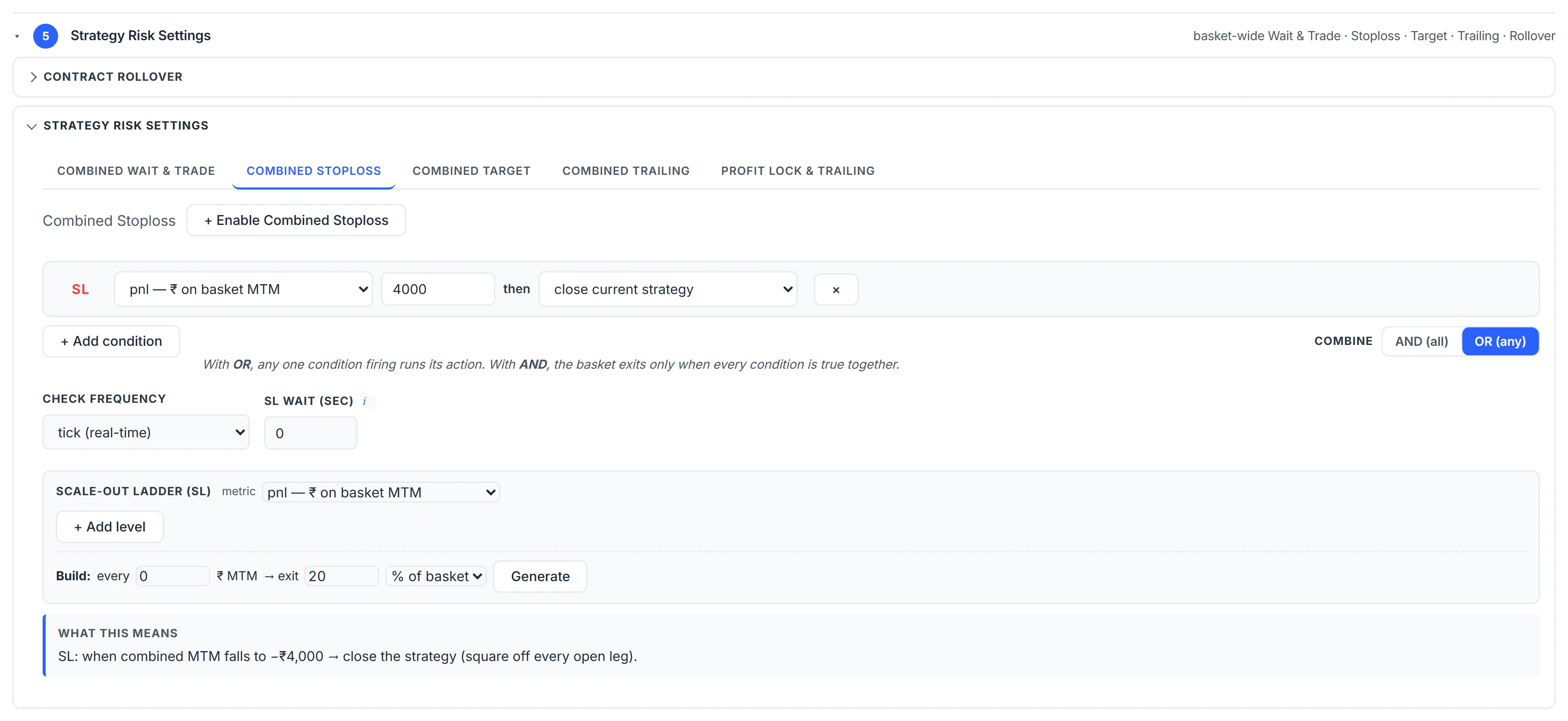
Combined trailing vs profit lock
These are two different ways to protect a profit, and the difference is who chooses where the floor sits.
Combined Trailing gives back a fixed amount from the peak. Once peak MTM reaches the trigger, the floor is trigger − lock, and every further step of peak raises it by the lock. A blank lock equals the step.
Profit Lock holds a floor you name. When MTM reaches ₹X, a floor of ₹Y is locked; every further ₹S of peak lifts it by ₹L. The floor can never exceed the peak. Falling back to the floor closes every leg.
Use Profit Lock when you can state the outcome: “once I am up ₹20,000, keep at least ₹18,000.” Arm one or the other, not both — they are checked on the same tick and the first to fire closes the basket. A combined target at or below the lock’s arm level will book the basket before the lock ever arms.
Worked examples
Trailing. Trigger ₹4,000, step ₹1,000, lock ₹1,000. Peak reaches ₹4,000: floor = 4,000 − 1,000 = ₹3,000. Peak reaches ₹6,500: two full steps, floor = 3,000 + 2 × 1,000 = ₹5,000. If MTM then falls to ₹5,000, everything closes.
Profit Lock. Reach ₹20,000, minimum ₹18,000, step ₹5,000, lift ₹2,000. At a ₹30,000 peak: 18,000 + floor(10,000 ÷ 5,000) × 2,000 = ₹22,000. At ₹40,000: 18,000 + 4 × 2,000 = ₹26,000. Notice the floor falls further behind as profit grows — ₹8,000 behind, then ₹14,000. Set lift equal to step for a constant give-back.
Common mistakes
- Rupee limits that do not scale with size. A ₹20,000 lock sized for 10 lots arms far too early on 17. Rescale basket ₹ values whenever lots change.
- Exit conditions on a rolling alias. A basket stop on MTM tracks what you actually hold; a condition on a moving signal may not. See the rolling ATM straddle.
- Re-entering without a cap that fits the day. Each cycle pays costs again.
Both trailing and profit lock can be edited on a running strategy from the forward-test or live position panel; if MTM is already below the new floor, you are warned with the floor, peak and current MTM before it applies. Leg-level rules are in per-leg stops.
Where to find it
- In Algo & Backtest, open Step 5.
- Pick a tab: Wait & Trade, Stoploss, Target, Trailing or Profit Lock.
- Set the measure, the trigger and the on-hit action.
- Backtest and compare the exit reasons across days.
Common questions
What is a combined stop loss in options trading?
A stop measured on the total P&L of all legs rather than any single leg. In Algo it can be set in rupees, as a percentage of entry premium, in points, on an underlying move, on net delta or on ATR.
What is the difference between trailing stop and profit lock?
Trailing gives back a fixed amount from the peak. Profit lock keeps a floor you specify once a profit level is reached, and lifts it in steps.
Can the strategy close and re-enter after a combined stop?
Yes. Choose close strategy and re-enter, set how many times it may repeat and an optional wait. It will not restart if any leg failed to exit.
Can I change profit lock on a running strategy?
Yes, from the forward-test or live position panel. If the new floor is already above current MTM you are warned before it applies, because it would close the position.
More on Algo & Backtesting
More in Algo & Backtesting · App: Algo & Backtest · Definitions: glossary · All: every article