What the rolling ATM straddle is
The rolling ATM straddle is a single premium series that always follows the at-the-money strike. At each moment it looks at the strikes around spot, adds each strike’s CE and PE premium, and takes the smallest CE + PE sum in a window of five strikes either side.
Why the minimum rather than the nearest strike? The cheapest straddle is the one whose call
and put are most balanced — the strike the market is treating as at the money. It is
frequently one strike away from round(spot / step), especially when futures trade
at a premium to spot.
In Algo this is a real instrument the platform publishes, not two legs summed in your browser. That matters for the metrics you can use on it.
Why a published series beats a locally summed one
Because it exists from 09:15 IST like any other instrument, VWAP,
DAY_HIGH and DAY_LOW on this alias are the session’s
values, weighted by real traded volume — not values that start the moment your strategy
was launched.
It also exposes STRIKE: the strike the series is built from right now. That
strike changes many times in a session as spot moves, which is the whole point of
“rolling”.
Trading the strike the signal fired on
If you enter on a signal from this series, set your legs’ strike mode to Rolling ATM. The legs then anchor on the strike the rolling straddle reports at that instant, with any distance (OTM1, OTM2…) applied on top of it rather than on top of spot.
If the strategy has no Rolling ATM Straddle watch on the same underlying, the engine refuses the Rolling ATM leg instead of falling back to the spot ATM. A fallback would fill a different contract from the one the signal was computed on, and it would look correct, which is exactly why it is refused.
Availability depends on the underlying, and the expiry dropdown only offers expiries that are actually published. NIFTY and SENSEX have weekly and monthly series; BANKNIFTY has monthly only. FINNIFTY, MIDCPNIFTY, BANKEX and stocks have none — use the ATM Straddle (locked strike) scope there. The expiry is always a relative choice such as “current weekly”, so a saved strategy keeps following the live contract.
A worked example
Spot is 25,010 and three strikes quote as follows (made-up numbers):
| Strike | CE + PE |
|---|---|
| 24,950 | 146 + 82 = 228 |
| 25,000 | 118 + 104 = 222 |
| 25,050 | 92 + 128 = 220 |
The nearest strike to spot is 25,000, but the smallest straddle is 25,050 at ₹220, so the
rolling series reads ₹220 and STRIKE reads 25,050. A strategy with the entry row
ROLL_STRDL.LTP < ROLL_STRDL.VWAP and two SELL legs in Rolling ATM mode at ATM
sells the 25,050 CE and PE. With OTM1 instead, a 50-point step puts the call at 25,100 and the
put at 25,000.
How the backtest replays it
The historical archive stores individual strikes, not the published series, so the backtest recomputes it with the same rule: one value per minute, the smallest CE close + PE close across five strikes either side. A strike missing either leg is skipped, so a one-sided quote can never masquerade as a cheap straddle. The expiry selector is re-resolved on each replay day, so “current weekly” means that day’s weekly.
It is close to live, not identical, and the report says so:
- The strike is re-picked once a minute in the replay; live re-picks continuously, so the two can differ inside a fast minute — often when a straddle signal fires.
DAY_HIGHandDAY_LOWare extremes of minute closes, so they read narrower than live.
Treat the backtest as directional evidence and confirm on a paper forward test.
Two things to set deliberately
Gate the open. The first VWAP cross often comes around 09:16, when VWAP is built from two minutes of data. Add a time row, such as after 09:30, unless you specifically want the open.
Decide what your exit watches. The alias keeps rolling after you are filled, while the straddle you sold stays on its strike. An exit written against the alias drifts away from the position it is meant to protect. Use per-leg stops or a combined MTM stop for anything that must track what you hold — see basket risk. For the straddle-versus-strangle trade-off itself, read straddle vs strangle.
Where to find it
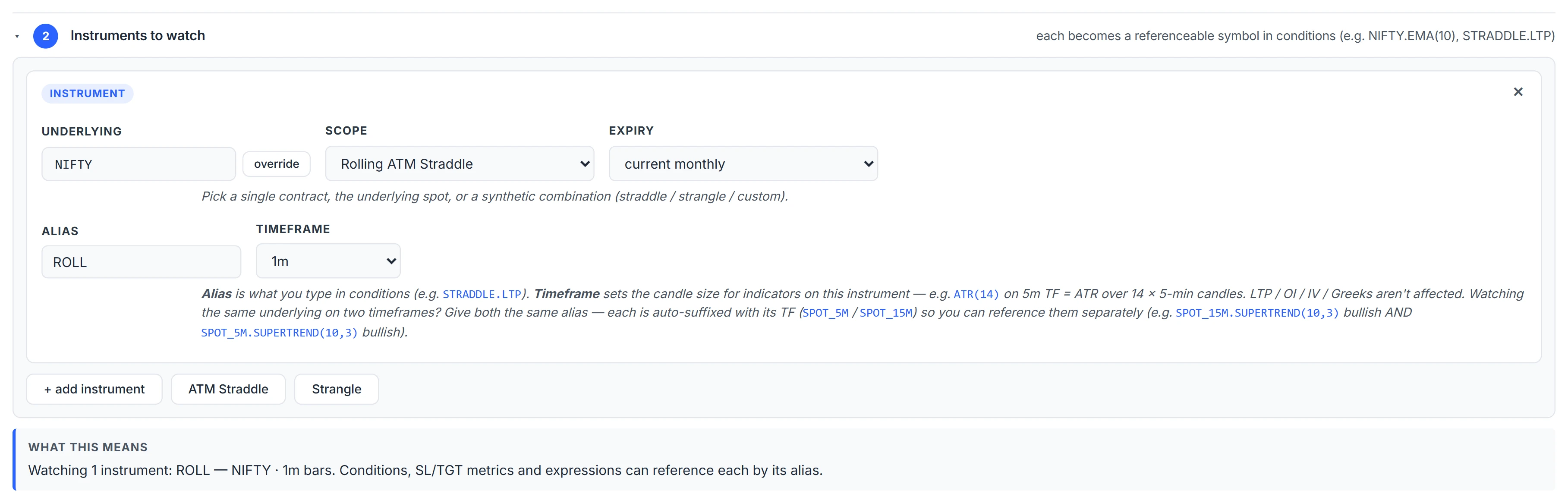
- In Algo & Backtest, open Step 2 and add an instrument.
- Set Scope to Rolling ATM Straddle and pick a relative expiry.
- Write your entry in Step 3A using the alias.
- In Step 4, set each leg’s strike mode to Rolling ATM.
Common questions
What is a rolling ATM straddle?
A premium series that always tracks the at-the-money straddle. Algo defines ATM as the strike with the smallest CE plus PE premium within five strikes either side of spot.
Why not just use the strike nearest to spot?
The nearest strike is arithmetic; the cheapest straddle is where the market is pricing the money. They often differ by a strike, and a signal on one with an order on the other is a mismatch.
Which underlyings have a rolling ATM straddle?
NIFTY and SENSEX publish weekly and monthly series and BANKNIFTY publishes monthly only. Other indices and stocks do not; use the locked-strike ATM straddle scope for them.
Can I backtest a rolling straddle strategy?
Yes. The backtest recomputes the series minute by minute from per-strike history using the same rule, and flags the small differences from live in its warnings.
More on Algo & Backtesting
More in Algo & Backtesting · App: Algo & Backtest · Definitions: glossary · All: every article