What the calculators page is
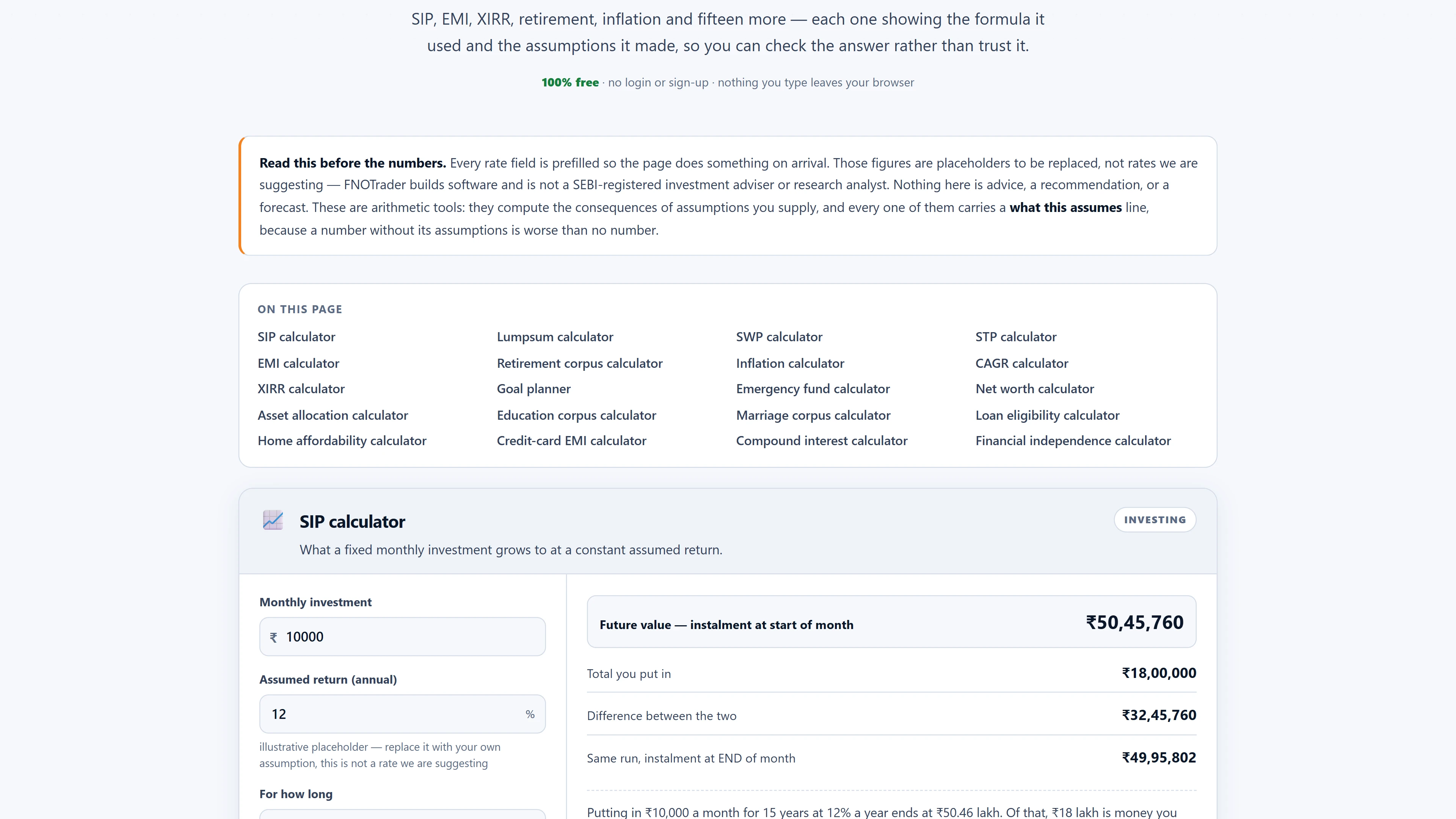
One page, twenty calculators, free and with no login. Each has its inputs on the left, its results on the right, and a sentence under the result that says what it means in words.
They are grouped by the job they do: investing, drawing down, borrowing, planning, measuring returns and the foundations of a household balance sheet. Each one also says what it assumes, and links to the article that explains the idea behind it.
Investing and drawing down
| Calculator | What it answers |
|---|---|
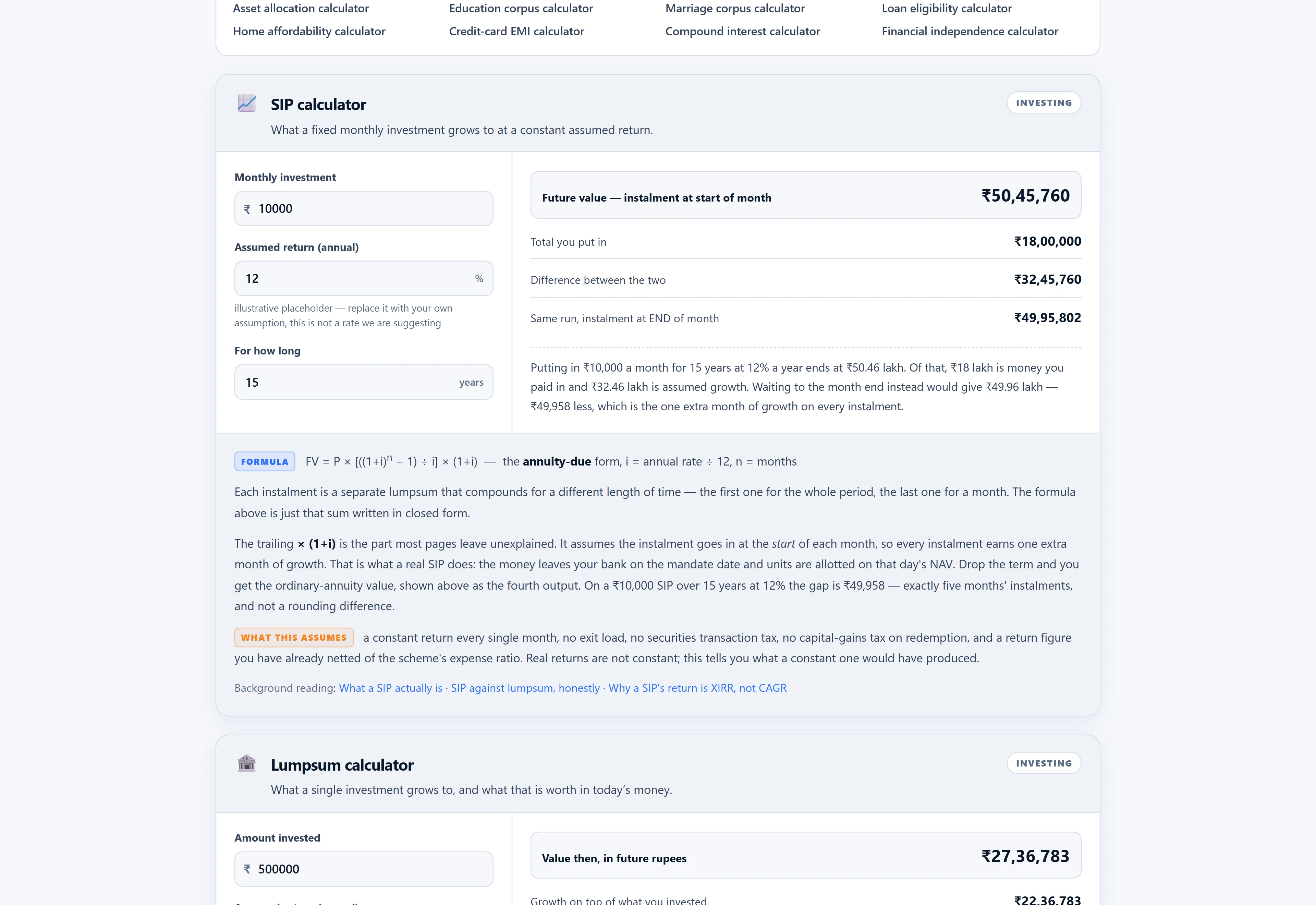
| SIP | What a fixed monthly investment grows to at a constant assumed return, and how much of it is money you put in. |
| Lumpsum | What a single investment grows to, and what that is worth in today's money. |
| STP | Moving a lumpsum into a target fund in monthly slices, with both funds earning meanwhile. |
| SWP | How long a corpus lasts if you withdraw a fixed amount every month, and the withdrawal that would leave the capital intact. |
Background: what is a SIP and SWP explained.
Borrowing
| Calculator | What it answers |
|---|---|
| EMI | The monthly instalment on a loan, and what the loan costs in total. |
| Loan eligibility | The loan an income supports, working back from the instalment a lender will allow (the FOIR share of income, less existing EMIs). |
| Home affordability | The property price your income and cash support once the loan-to-value cap and buying costs are included. |
| Credit-card EMI | The instalment, and the annual rate the arrangement really costs once the processing fee and GST are counted. |
Background: how an EMI is built and loan eligibility explained.
Planning, returns and foundations
| Calculator | What it answers |
|---|---|
| Retirement corpus | The corpus that funds an inflation-linked income for life, and the SIP that builds it from where you are. |
| Goal planner | What a target costs by the time you get there, and the monthly or one-time investment it takes. |
| Education corpus | A multi-year course, escalated at education inflation and discounted back to the start date. |
| Marriage corpus | A single dated expense, inflated to the date and worked back to a monthly figure. |
| Financial independence | How many years of saving before a portfolio could cover your expenses at a chosen withdrawal rate. |
| Inflation | What a price becomes, what money loses, and the real return on top. |
| CAGR | The single annual rate that turns one value into another over a period. |
| XIRR | The annualised return on cashflows on irregular dates, solved numerically. |
| Compound interest | What compounding frequency does to the same headline rate. |
| Emergency fund | How large a cash buffer your essential expenses imply, and how long it takes to build. |
| Net worth | Everything you own less everything you owe, with the home and its loan shown separately. |
| Asset allocation | How far your portfolio has drifted from your chosen equity, debt and gold split, in rupees. |
The conventions behind every number
- Monthly rate = annual rate ÷ 12. The convention Indian SIP calculators and lenders use. It is nominal: 12% means 1% a month, which compounds to 12.68% a year.
- Real return = (1 + return) ÷ (1 + inflation) − 1, never return minus inflation. At 12% and 6% that is 5.66%, not 6%, and the gap compounds every year.
- SIP instalments arrive at the start of the month (annuity-due), like a real mandate. SWP withdrawals are taken at the end of the month, after that month's growth.
- XIRR is solved, not approximated. Enter dated cashflows, negative for money in and positive for money out or the closing value; the calculator searches for the rate at which they net to zero.
- Not modelled: tax, exit loads, costs, and the order in which returns arrive. A constant return is a convenience, not a forecast.
Why XIRR rather than CAGR for a SIP is explained in XIRR vs CAGR.
A worked example
Hypothetical: a ₹10,000 monthly SIP for 10 years at an assumed 12%.
The monthly rate is 1% and there are 120 instalments. The growth factor is (1.01120 − 1) ÷ 0.01 ≈ 230.0. Paid at month-end, that is about ₹23.0 lakh; paid at the start of each month, as a SIP is, multiply by 1.01 for about ₹23.2 lakh. You paid in ₹12 lakh, so about ₹11.2 lakh is assumed growth.
At 6% inflation, the real rate is 1.12 ÷ 1.06 − 1 = 5.66% a year. Ten years of 6% inflation divides the corpus by 1.0610 ≈ 1.79, so ₹23.2 lakh then buys roughly what ₹13 lakh buys today. Both numbers are true; they answer different questions.
Where to find it
- Open /calculators. No login is needed.
- Jump to a calculator from the index at the top, or scroll by group.
- Read the assumptions line under each one before you rely on the result.
Position sizing, Kelly and risk of ruin are on the trading calculators page instead. To test a SIP on real fund history rather than an assumed rate, use the Mutual Funds app.
Common questions
Which SIP formula does the SIP calculator use?
The annuity-due form, FV = P × [((1 + i)^n − 1) ÷ i] × (1 + i), with i as the annual rate ÷ 12 and n as the number of months, because SIP instalments are debited at the start of the period.
Why is the real return not just return minus inflation?
Because both compound. The real rate is (1 + return) ÷ (1 + inflation) − 1, so 12% with 6% inflation is 5.66%, not 6%.
How is XIRR calculated?
You enter dated cashflows, negative for money in and positive for money out or the final value. The calculator solves for the single annual rate at which all of them, weighted by time invested, net to zero.
Do the calculators include tax?
No. None of them model tax, exit loads or transaction costs, and they assume a constant return. Each calculator states its assumptions under the result.
Are these calculators free?
Yes, all twenty are free and need no login.
More on Platform & setup
More in Platform & setup · App: Calculators · Definitions: glossary · All: every article