What it is, and why one return number is not enough
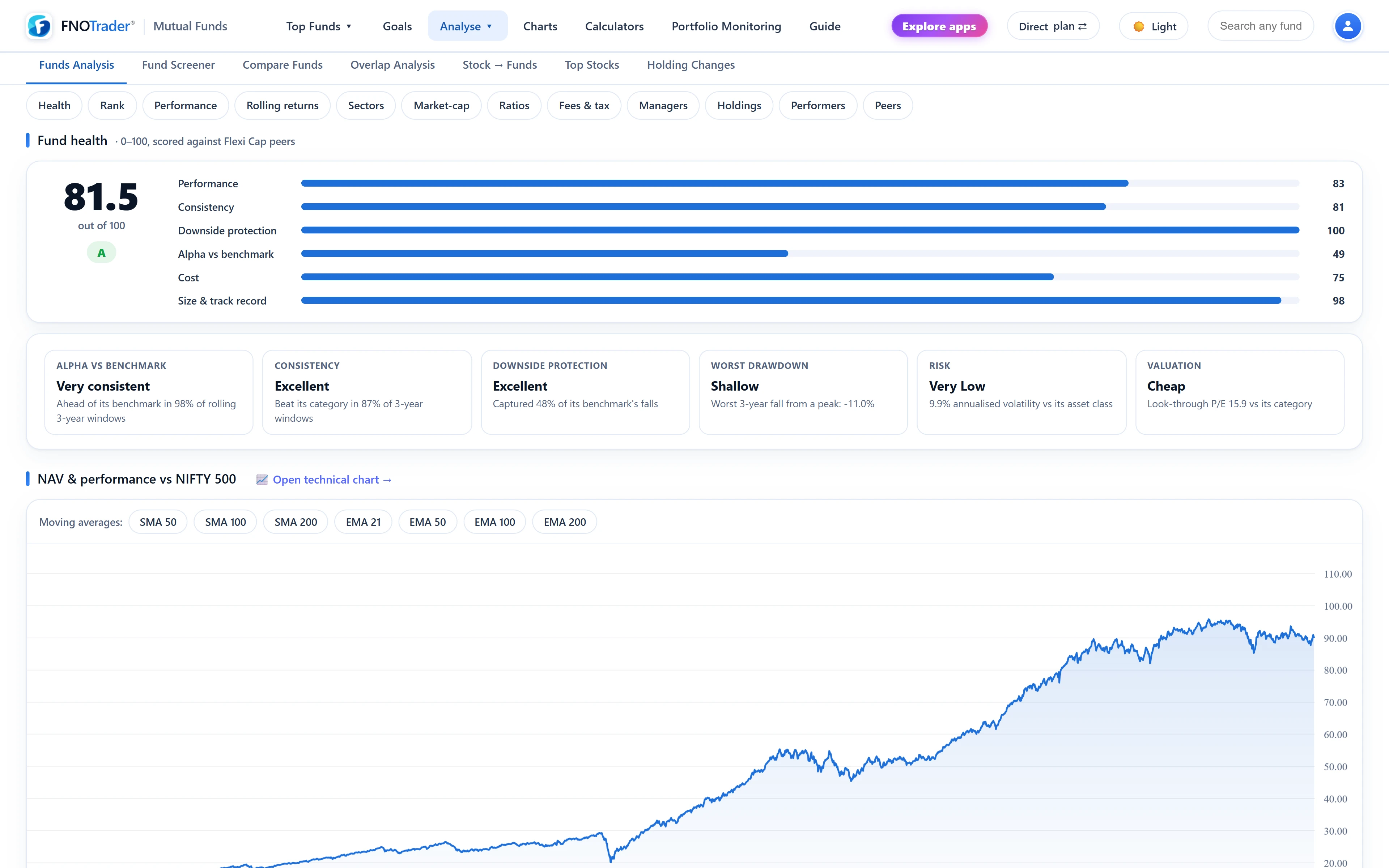
The Health score is a composite: six dimensions of a fund's record, each ranked against the fund's own category peers, then blended into a score from 0 to 100 and a letter grade.
The reason for a composite is simple. Trailing returns reward whoever had the best start date. A fund that rallied hard in the last eighteen months can lead the 3-year table while having lagged its category for most of its life, fallen further than peers in every correction and charged more for the privilege. Each of those is visible in a separate column; the Health score makes you look at them together.
It is peer-relative by design. A liquid fund scoring 85 is excellent among liquid funds. It is not a claim that it beats an equity fund scoring 60.
The six dimensions and their weights
| Dimension | Weight | Measured by |
|---|---|---|
| Performance | 25% | Median rolling 3-year return — not the trailing 3Y CAGR, so one lucky start date cannot carry it |
| Consistency | 20% | The consistency score: how often the fund beat its category over rolling 3-year windows, how rarely it lost money, how tight the spread was |
| Downside protection | 20% | A blend of downside capture (lower is better), maximum 3-year drawdown (shallower is better) and Sortino ratio |
| Alpha vs benchmark | 15% | For active funds, the information ratio. For index funds and ETFs, the tracking error filed with AMFI, where lower is better |
| Cost | 10% | Expense ratio, lower is better |
| Size & track record | 10% | Fund size (AUM, on a log scale) plus years of NAV history, capped at 15 years |
Each dimension is converted to a percentile from 0 to 100 inside the fund's peer group — the SEBI sub-category and the plan, Growth option only. Percentiles are computed only over the funds that actually have that metric, so a scheme with a missing number does not quietly drag everyone else's percentile down.
The alpha dimension asks a different question of passive funds on purpose. An index fund is not trying to beat its index, so it is judged on how closely it tracked. Because a passive category contains only passives, the two measures are never ranked against each other.
The two guards: five peers, half the weight
A fund needs at least five peers in its category and plan to be scored. Below that, a percentile is too coarse to mean anything.
It also needs at least half of the total weight to be computable. If a dimension has no data — a fund too young for rolling 3-year windows, or one with no benchmark — that dimension is dropped and the remaining weights are scaled back up to 100%. The fund page then states the coverage, for example "built on 85% of the framework", so a partial score is labelled as partial. A fund with only two dimensions available gets no score rather than a flattering one built from whatever happened to exist.
Grades
| Score | Grade |
|---|---|
| 85 and above | A+ |
| 75–85 | A |
| 65–75 | B+ |
| 55–65 | B |
| 45–55 | C+ |
| 35–45 | C |
| 25–35 | D |
| Below 25 | E |
A worked example with a missing dimension
A hypothetical mid-cap fund has these percentiles within Direct mid-cap funds: performance 80, consistency 70, downside 60, cost 90, size and track record 50. It has no information ratio, so the alpha dimension is missing.
- Weighted points: 80 × 0.25 + 70 × 0.20 + 60 × 0.20 + 90 × 0.10 + 50 × 0.10 = 20 + 14 + 12 + 9 + 5 = 60
- Available weight: 0.25 + 0.20 + 0.20 + 0.10 + 0.10 = 0.85, which clears the 0.5 floor
- Score: 60 ÷ 0.85 = 70.6, grade B+, coverage 85%
The breakdown bars on the fund page show those five numbers, with alpha marked as missing. If you disagree with the weighting — say you care about cost more than track record — the bars give you everything you need to re-weigh it yourself.
How to read it, and how not to
- Compare within one category. The screener shows a warning banner when you filter or sort on Health across several categories, because the numbers were never on one scale.
- It is a description, not advice. The score summarises the record. It does not know your goals, horizon or tax position.
- Read the weakest bar. Two funds at 72 can get there very differently. One may be strong everywhere; another may hide a poor downside score behind low cost.
- Background reading: rolling returns, expense ratios and risk measures cover the ingredients in depth.
Where to find it
- Open any fund in Mutual Funds; the Health section is first in the jump bar. Hover a bar to see its contribution.
- In any fund table, the Health column shows the score and grade; click the header to sort.
- In Analyse → Fund Screener, use "Health score ≥" or the grade filter. The fund page walkthrough explains the inputs.
Common questions
What is a good Fund Health score?
Grades run A+ (85 and above) to E (below 25). Because the score is ranked within the category, an A means the fund is near the top of its own peer group, not that it beats funds in other categories.
Why does a fund have no Health score?
Either its category and plan has fewer than five funds, or less than half of the six dimensions could be computed, usually because the fund is too young for rolling 3-year windows.
Why does the Health score use rolling returns instead of 3-year CAGR?
A single trailing return depends heavily on the start date. The median of every rolling 3-year window describes what holders actually experienced across the fund's life.
How are index funds scored on alpha?
Index funds are judged on tracking error filed with AMFI, where lower is better, instead of information ratio. Passive categories contain only passive funds, so the two are never mixed.
More on Mutual Funds
More in Mutual Funds · App: Mutual Funds · Definitions: glossary · All: every article