What the finder is, and the mistake it fixes
Choosing an option strategy is three questions, not one: which way, how much movement, and how much risk you can handle.
Take a long call and a short put. Both are bullish, and between their break-evens their payoffs look alike. Outside that band they invert: the long call's loss stops at the premium, the short put's keeps falling; the short put's gain stops at the premium, the long call's keeps climbing. They agree on outlook and disagree on volatility, theta and maximum loss. A picker that sorts by direction alone puts them under the same heading.
Options School classifies 71 strategies on several axes at once, so you can narrow the list to the ones that fit the market you actually expect.
How to use the filters
| Filter | Choices |
|---|---|
| Strategy family | Basic, Income, Vertical, Volatile, Sideways, Leveraged, Synthetic |
| Market outlook | Bullish, Bearish, Neutral |
| Type of market | Volatile, Range, Trending / any |
| Your experience | Novice, Intermediate, Advanced, Expert |
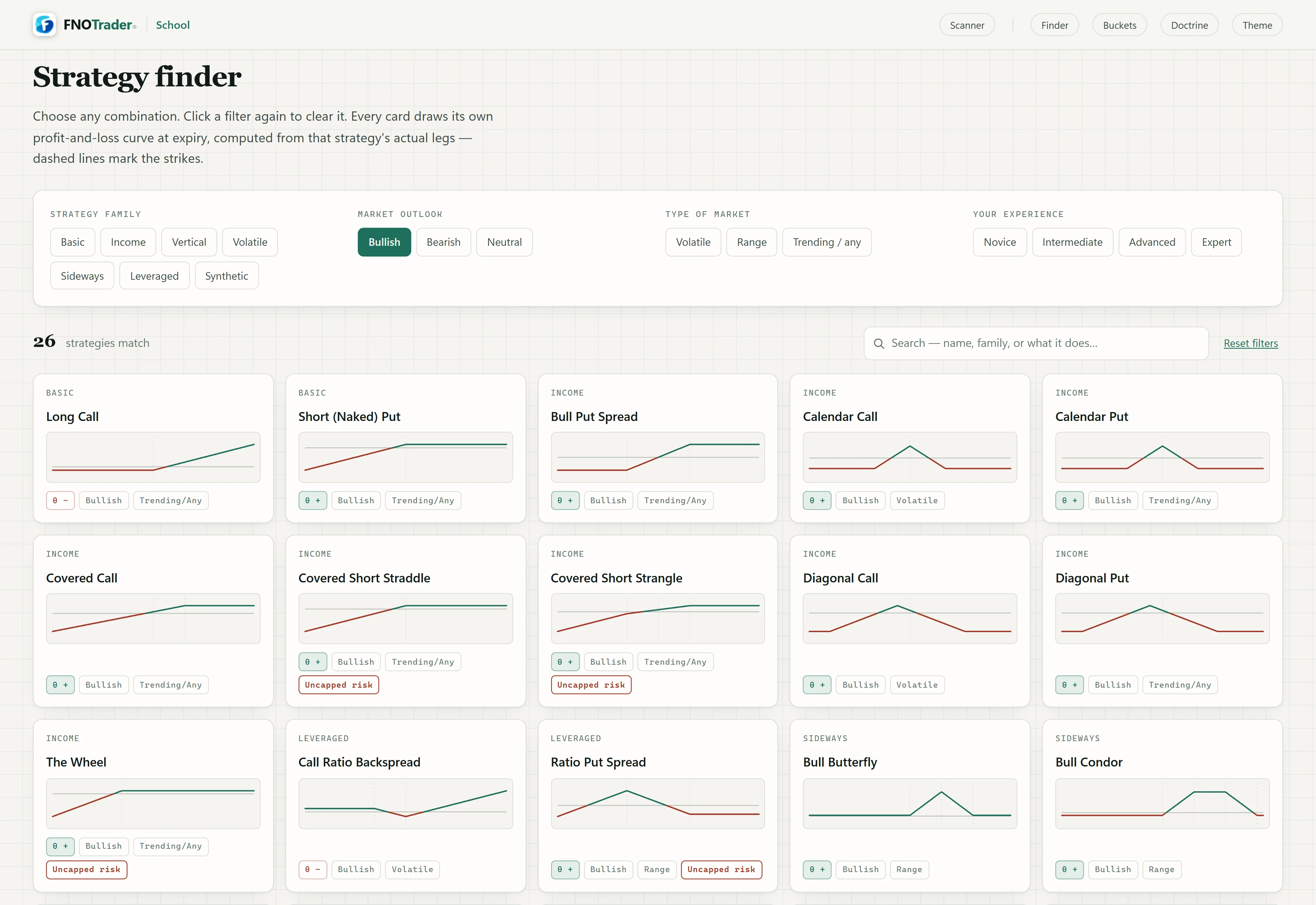
Combine any of them; click a filter again to clear it. A search box matches words in the name, family and the deployment notes, so “VIX” or “support” finds the strategies whose rules mention them. If no strategy fits a combination, the page says so rather than showing a near miss.
Every card draws its own profit-and-loss curve at expiry from that strategy's legs: green is profit, red is loss, the thin horizontal line is break-even and the dashed verticals are strikes. A flat green shelf means capped reward; a line that keeps climbing means uncapped. Chips show whether theta works for you or against you, and the outlook. The curves are schematic — shape and break-even structure, not live prices.
The buckets worth reading
Below the finder, the page explains its classifications. Three are worth knowing before you pick anything:
- Names lie. Some strategies are classified opposite to what they are called. A Bull Put Ladder is bearish, because its extra long put profits on a crash; a Bear Call Ladder is bullish for the mirror reason; a Ratio Call Spread is bearish because it is net short the further-out calls.
- Experience tracks risk. Novice strategies are directional only — a long call, a long put, a covered call and the two synthetics. Every range and volatility structure is multi-leg. Almost all the uncapped-risk strategies sit at the advanced and expert levels; none is at novice.
- The worst shape in options is uncapped risk with capped reward: unlimited downside for a fixed payment. Short straddles and strangles, naked calls and ratio spreads are on that list. They are legitimate in the right conditions, and they are the ones to size smallest.
Each strategy's NIFTY playbook
Click a card and its page opens with the classification (family, outlook, market, experience, whether it earns by income or capital gain, maximum risk and reward, and time decay), the legs, and what theta and gamma mean for that shape. Then four rules:
| Rule | What it says |
|---|---|
| Conditions to deploy | The view and market conditions the structure needs, such as a VIX level, days to expiry, or where the short strike should sit against support |
| Stop — where you are wrong | A price stop, and for short premium a stop on the structure's own price, usually around twice the credit taken |
| Adjustment | The repair if it goes against you, and how many times it is allowed |
| Profit exit | Where to book, rather than holding for the last rupee of decay |
Each page also prices a worked example on the NIFTY chain, stamped with the date and time it was priced, and lists stocks the scanner matched to that structure. Premiums move; the structure does not, so treat the example as a template and re-price it. The live version of that matching is the strategy scanner.
A worked example: a bull put spread
Hypothetical numbers, NIFTY at 24,000, lot size 65. You expect NIFTY to hold above 23,800 into expiry.
- Sell the 23,800 put at 120, buy the 23,600 put at 70. Net credit 50 points, or ₹3,250 per lot.
- Strike width 200, so maximum loss is 200 − 50 = 150 points, or ₹9,750 per lot.
- Break-even is 23,800 − 50 = 23,750.
- Profit exit at 50% of the credit: buy it back at 25, banking 25 points, ₹1,625.
- Premium stop at twice the credit: exit if the spread marks 100, a 50-point loss of ₹3,250 per lot, even if 23,800 has not broken.
The adjustment rule for this structure is to roll down and out once, and only for a further credit. Paying to repair turns a defined loss into a larger one. For why the hedge also cuts the margin, see SPAN margin explained.
The four rules underneath all of it
- Plan the exit before the entry. Write down the assumption the trade rests on — not “I'm bullish” but “NIFTY holds 24,800 through Tuesday” — and exit when it is falsified.
- If you are wrong, get out. Staying too long, or making too many modifications, is the common mistake.
- Roll winners, never losers. A losing position gets one defensive roll, and only for a credit.
- Two stops: price and time. A negative-theta position needs a date beyond which you will not carry it.
Two Indian points the page adds: STT is charged on the intrinsic value of exercised in-the-money options, so square off an ITM long rather than letting it expire; and hedged structures need far less margin than naked ones.
Where to find it
- Open learn.fnotrader.com. No login is needed.
- In Strategy finder, pick an outlook, a market type and your experience level.
- Read the payoff curves, open a card, and read its deploy, stop, adjustment and exit rules.
- Open the Scanner from the top bar to see which structures fit today's market.
Range structures on the index are covered in more depth in NIFTY range structures. Everything here is educational reference, not investment advice.
Common questions
How do I choose an option strategy?
Decide three things: direction (bullish, bearish or neutral), market type (volatile, range-bound or trending) and how much risk you can manage. Options School filters its strategies on exactly those axes.
Is Options School free?
Yes. learn.fnotrader.com is free and needs no login.
Why is a bull put ladder classified as bearish?
Its extra long put means the position profits if the market crashes, so its payoff leans bearish despite the name.
Which option strategies are riskiest?
Those with uncapped risk and capped reward, such as short straddles, short strangles, naked calls and ratio spreads. They trade unlimited downside for a fixed premium.
Are the payoff curves live prices?
No. The finder's curves are schematic shapes computed from each strategy's legs at expiry. The worked example on each strategy page is priced on a NIFTY chain snapshot with its date shown.
More on Options School
More in Options School · App: Options School · Definitions: glossary · All: every article