What the two tools do
Goals is a shortcut into the right neighbourhood of funds. The calculators answer "how much do I need to put in" and "what might this grow to" for a given assumed return.
Neither is a recommendation. The category is the decision; the Goals list saves you mapping it manually. The calculator is a projection; it is not a backtest and not a forecast. The planning concepts behind both are covered in goal-based investing.
The twelve goals and how each is ranked
| Goal | Categories | Ranked on |
|---|---|---|
| Wealth Builder | Flexi, Multi, Large & Mid, Large Cap, Focused, Value, Contra, Dividend Yield | 5Y CAGR |
| High Growth | Mid Cap, Small Cap | 5Y CAGR |
| Bluechip | Large Cap | 5Y CAGR |
| Steady Income | Corporate Bond, Banking & PSU, Short and Medium Duration, Dynamic Bond, Floater, Conservative Hybrid, Equity Savings | 3Y CAGR |
| Tax Saver | ELSS | 5Y CAGR |
| Thematic | Thematic, Sectoral | 3Y CAGR |
| Index Funds | Index funds and ETFs, excluding target maturity and debt index | AUM |
| Park Your Money | Liquid, Overnight, Ultra Short, Money Market, Low Duration | 1Y return |
| Debt & Bond | All debt and gilt categories | 3Y CAGR |
| All-Weather | Dynamic Asset Allocation, Aggressive Hybrid, Multi Asset Allocation | 3Y CAGR |
| Overseas | Overseas and international fund categories | 1Y return |
| Gold & Silver | Commodity funds | 3Y CAGR |
The ranking metric follows the goal. Index funds are ranked by size because, for a tracker, scale and cost matter more than small return differences. Parking funds are ranked on one year because no one parks money for five.
Lists use Direct-Growth funds with at least 100 NAV points and a NAV no more than 15 days old. Plan and option variants of the same fund collapse to one row, so you see distinct funds rather than one fund four times. Remember the category traits: ELSS carries a three-year lock-in, and thematic funds concentrate risk by construction.

The calculators: two directions, three modes
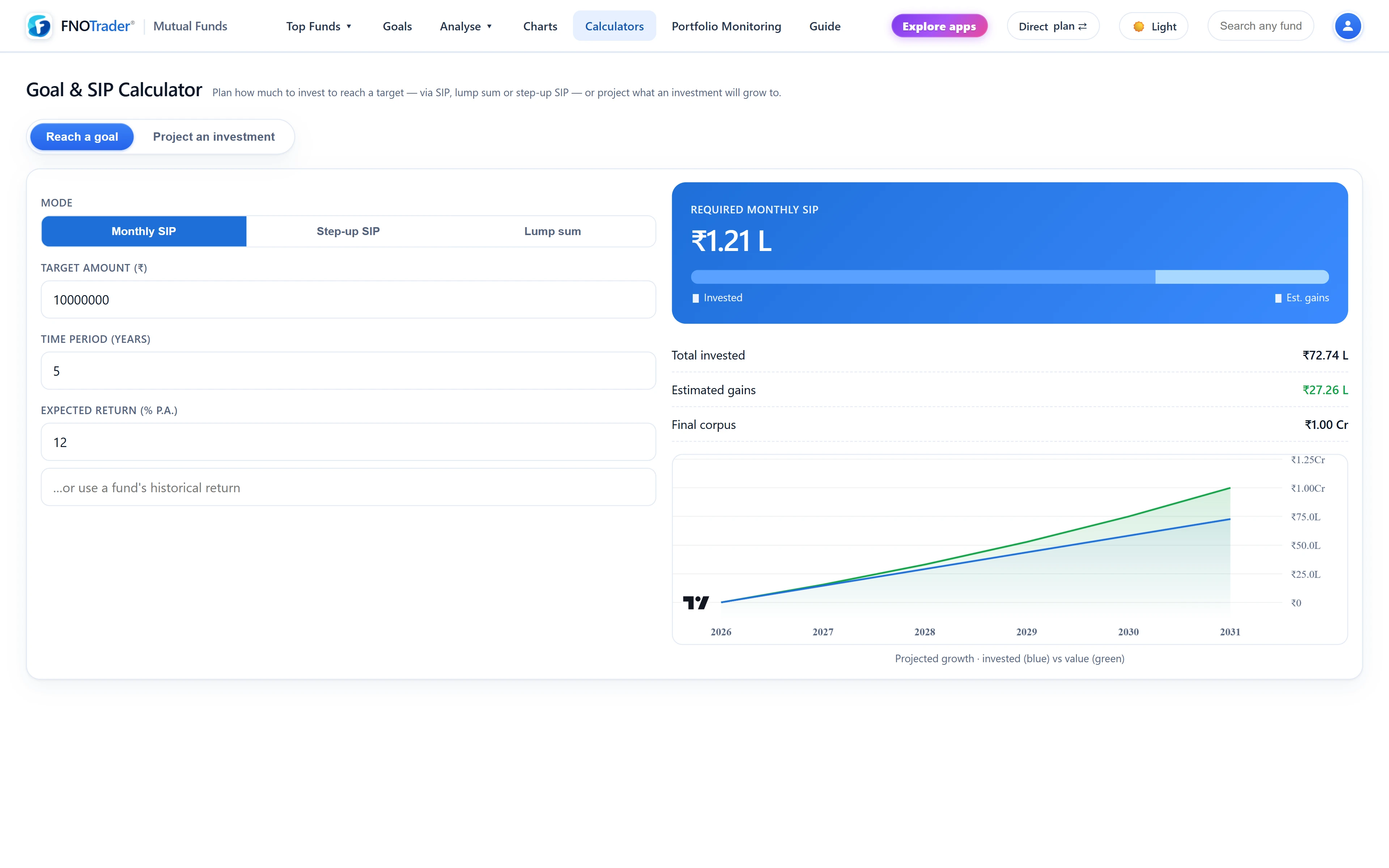
Reach a goal solves for the monthly SIP, the starting SIP of a step-up plan, or the lump sum needed to hit a target. Project an investment takes the amount and shows what it grows to. Each result splits total invested from estimated gains and draws a year-by-year chart of both.
| Mode | How it compounds |
|---|---|
| Monthly SIP | Monthly rate = annual rate ÷ 12. Each instalment is invested at the start of the month and grows for that month |
| Step-up SIP | Same, with the instalment raised by your step-up percentage after every 12 instalments |
| Lump sum | Compounded once a year at the annual rate |
For the return assumption, type any number, or search a fund and pull in its historical CAGR — 5Y if it has one, else 3Y, else 1Y — which the page labels with the window used.
Worked examples you can redo
SIP projection. ₹10,000 a month for 10 years at an assumed 12% a year. The monthly rate is 1%, there are 120 instalments, and each grows from the start of its month. The future value is 10,000 × [(1.01120 − 1) ÷ 0.01] × 1.01, about ₹23.2 lakh, on ₹12 lakh invested.
Step-up. The same plan raised 10% every year ends near ₹33.7 lakh on about ₹19.1 lakh invested.
Solving for a goal. To reach ₹50 lakh in 15 years at an assumed 12%, one rupee a month grows to about ₹504.6, so the SIP needed is 50,00,000 ÷ 504.6, roughly ₹9,900 a month.
Lump sum. ₹1 lakh for 10 years at 12% is 1,00,000 × 1.1210, about ₹3.1 lakh.
What a projection is not
- It is constant-rate arithmetic. Real returns arrive unevenly, and the order matters for a SIP. A historical SIP result needs a backtest on real NAVs, which these calculators do not run.
- A fund's past CAGR is an anchor, not a promise. Pulling in a 5Y CAGR from a strong period and projecting it fifteen years forward is the most common way people overestimate.
- No tax, no inflation. The corpus is nominal and pre-tax. For timing questions see SIP vs lump sum and what is a SIP.
Where to find them
- In Mutual Funds, click Goals in the menu and pick a goal card.
- Click Calculators, choose Reach a goal or Project an investment, then Monthly SIP, Step-up SIP or Lump sum.
- Optionally search a fund to use its historical CAGR as the assumption. To shortlist inside a goal's categories, the Fund Screener goes further.
Common questions
How does the FNOTrader SIP calculator compound?
It uses a monthly rate of the annual rate divided by 12, with each instalment invested at the start of the month. Step-up raises the instalment after every 12 instalments.
How much SIP do I need for 50 lakh in 15 years?
At an assumed 12% a year, roughly 9,900 rupees a month. At a lower assumed return the SIP needed rises, so test several rates.
Is the calculator a backtest of the fund?
No. It applies one constant rate. Choosing a fund only copies its historical CAGR into the assumption field.
Which funds appear on the Goals page?
Direct-Growth funds from the categories mapped to that goal, with at least 100 NAV points and a recent NAV, ranked on the goal's metric with plan variants collapsed.
Is Goals a recommendation?
No. It groups categories under plain-language goals and ranks past results. Whether a category suits you depends on your horizon and risk.
More on Mutual Funds
More in Mutual Funds · App: Mutual Funds · Definitions: glossary · All: every article