What the two screens do
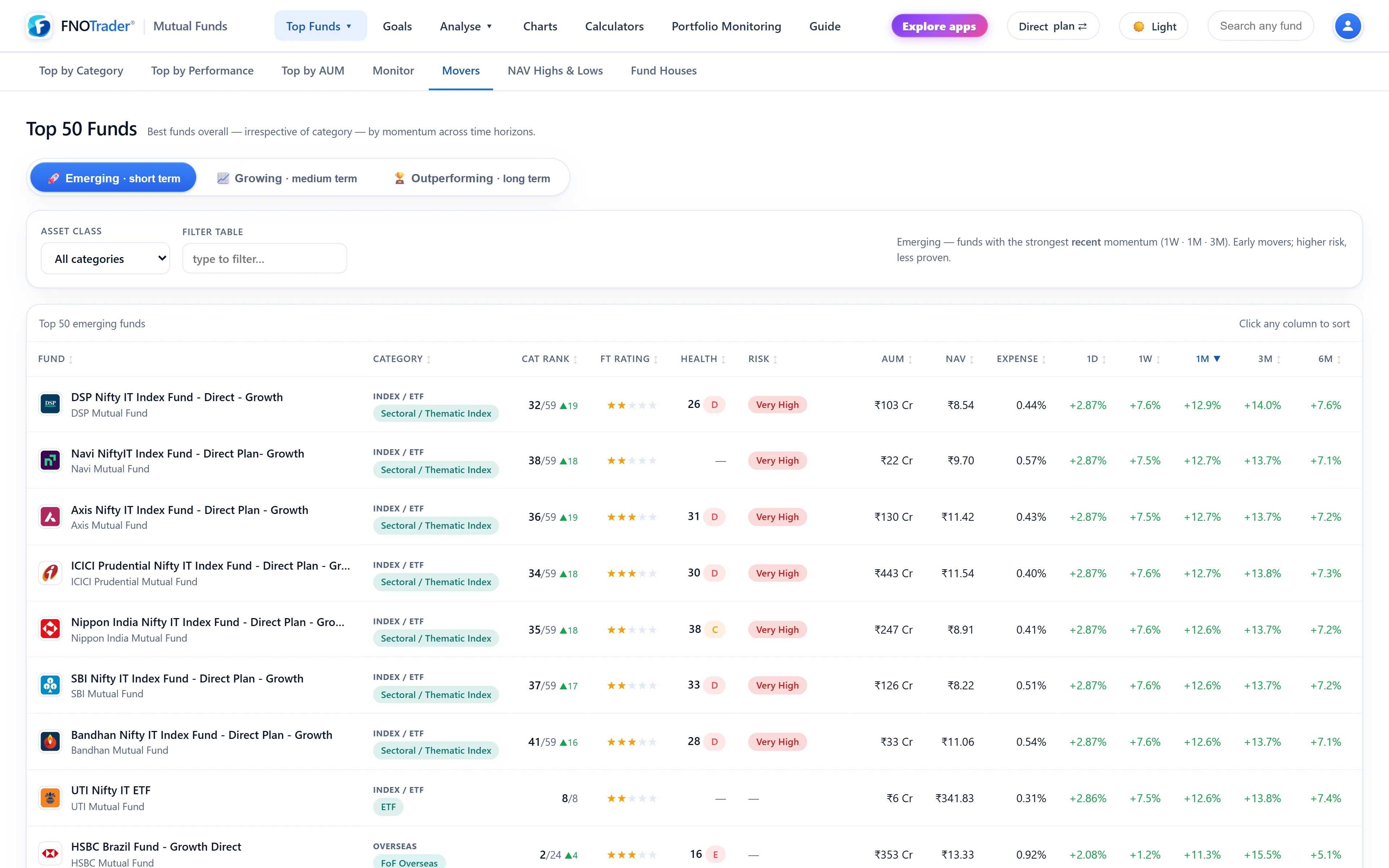
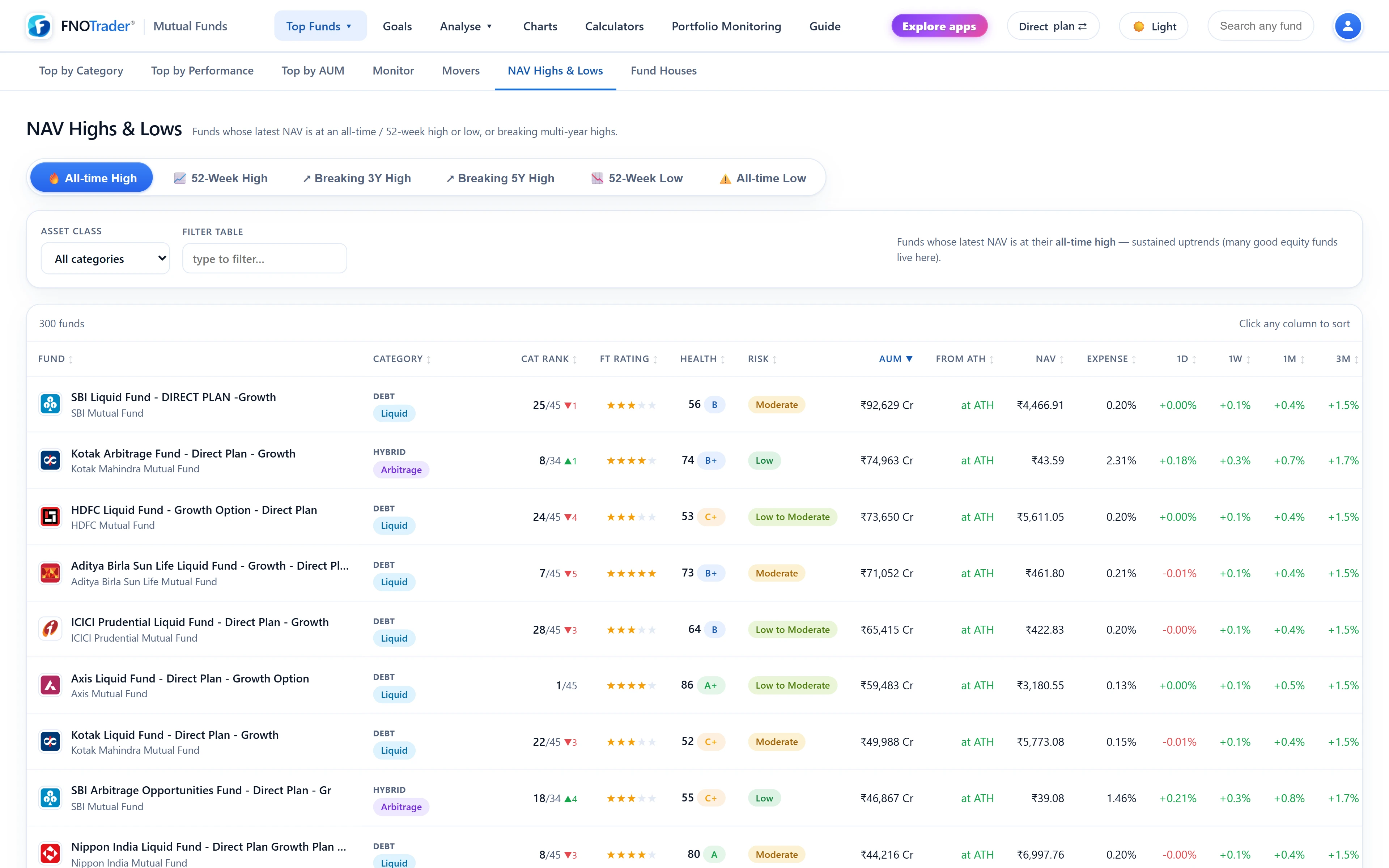
Movers ranks the top 50 funds across all categories on three momentum blends. NAV Highs & Lows lists funds sitting at a NAV milestone today. Both are descriptions of the current state of the market, not shortlists on their own.
Both follow the global Direct/Regular plan toggle, use the Growth option, and only include funds with at least 60 NAV points and a NAV no more than 15 days old.
How Movers scores funds
| Bucket | Score | Answers |
|---|---|---|
| Emerging | 0.5 × 1M + 0.3 × 3M + 0.2 × 1W | What has started moving recently |
| Growing | 0.4 × 6M + 0.4 × 1Y + 0.2 × 3M | What has been building over the medium term |
| Outperforming | 0.4 × 3Y CAGR + 0.4 × 5Y CAGR + 0.2 × 1Y | What has compounded over the long run |
A fund must have the bucket's main window to qualify: a 1M return for Emerging, 6M for Growing and a 3Y CAGR for Outperforming. A missing secondary window counts as zero, so a four-year-old fund can enter Outperforming, but without a 5Y figure it competes with 40% of its score missing.
Worked example. A hypothetical fund with 1M = 4%, 3M = 9% and 1W = 1% scores 0.5 × 4 + 0.3 × 9 + 0.2 × 1 = 2 + 2.7 + 0.2 = 4.9 in Emerging. A fund with 1M = 6%, 3M = 3% and 1W = −1% scores 3 + 0.9 − 0.2 = 3.7 and ranks below it, despite the bigger one-month move.
Use the asset-class filter. A momentum list mixing small-cap equity with liquid funds is not a shortlist, it is a market summary.
How NAV Highs & Lows decides a milestone
The thresholds are deliberately not exact equality, so a fund a whisker below its high still counts:
| Milestone | Condition |
|---|---|
| All-time high | NAV within 0.5% of its highest ever |
| All-time low | NAV within 0.5% of its lowest ever |
| 52-week high | NAV within 2% of its 1-year high |
| 52-week low | NAV within 2% of its 1-year low |
| New 3-year high | NAV within 1% of its 3-year high |
| New 5-year high | NAV within 1% of its 5-year high |
Each fund gets one main label, in priority order: all-time high, then all-time low, then 52-week high, then 52-week low. The 3-year and 5-year lists are checked separately. High lists are sorted by AUM; low lists by how far the fund sits below its all-time high.
Example: a fund whose highest NAV ever is ₹100 and whose NAV today is ₹99.60 is 0.4% below it, so it lists as an all-time high. At ₹99.40 it is 0.6% below, falls outside 0.5%, and is checked next against its 52-week high.
A NAV high is not a signal
An equity fund that has done its job is at or near an all-time high much of the time; that is what compounding looks like. A debt fund is almost always at one, because its NAV accrues interest daily. Read the highs list as a state of the book. The lows list is more informative — a fund at a 52-week low while its category is not is worth a look at the fund page — but it is still a prompt to investigate, not a trigger. For why NAV level itself says nothing about value, see mutual fund NAV explained.
Common mistakes
- Buying the Emerging list. Short-term momentum in funds mostly reflects the category's recent move. Check the fund's rank within its own category.
- Ignoring category on the lows list. If a whole category is at 52-week lows, the list is telling you about the market, not the funds.
- Treating 50 as a universe. Movers shows the top 50 by score; a filtered asset class gives a more useful 50.
Where to find it
- In Mutual Funds, open Top Funds → Movers, or Top Funds → NAV Highs & Lows.
- Pick a bucket or milestone, then narrow to one asset class.
- Click a fund to check its rolling returns and peers. For chart-based versions of these lists, see NAV charts and technical watchlists.
Common questions
How are mutual fund movers calculated?
Each bucket is a weighted blend of trailing returns: Emerging uses 1M, 3M and 1W; Growing uses 6M, 1Y and 3M; Outperforming uses 3Y CAGR, 5Y CAGR and 1Y.
What counts as a fund at its all-time high?
A NAV within 0.5% of the highest NAV the fund has ever published. The 52-week high uses a 2% band.
Should I invest in funds at an all-time high?
A NAV high on its own says little. Healthy equity funds and almost all debt funds spend much of their time near highs. Look at the fund's record against its category instead.
Do these lists follow the Direct or Regular plan setting?
Yes. Both Movers and NAV Highs and Lows use the plan chosen with the plan button in the top bar.
More on Mutual Funds
More in Mutual Funds · App: Mutual Funds · Definitions: glossary · All: every article