What is IV in options?
Implied volatility (IV) is the volatility the market is paying for, worked backwards from an option's price. Higher IV means a more expensive option for the same strike and expiry. IV is quoted as an annualised percentage, so an ATM IV of 16% on NIFTY means the options are priced for roughly that much annualised movement.
IV is not a forecast that the price will rise or fall. It is a price for movement in either direction.
How does IV crush work?
An option's premium is intrinsic value plus time value, and time value depends heavily on IV. Its sensitivity to IV is vega: the rupee change in premium for a one-point change in IV.
Before a scheduled event, IV in the expiry that contains the event rises, because sellers want more for the risk of a gap. After the event:
- The uncertainty is resolved, so the extra IV is no longer justified.
- IV falls, often within minutes of the open.
- Every long option loses roughly vega × the IV drop, on top of normal time decay.
If the stock's actual move is smaller than what the premium implied, the IV loss outweighs the directional gain. That is the classic "I was right on direction and still lost" trade.
A worked example
Hypothetical numbers for illustration. A stock trades at ₹1,000 the day before results. The ATM 1,000 CE costs ₹40, with IV at 45% and vega of ₹1.2 per IV point.
Results come out and the stock opens at ₹1,020, a 2% move in your favour.
- Delta gain: about 0.5 × ₹20 = +₹10
- IV falls from 45% to 30%: 15 points × ₹1.2 = −₹18
- One day of theta: about −₹2
The new premium is about ₹30, a 25% loss on a correct directional call. The ATM straddle cost about ₹80 before results, which implied a move of roughly ±8%. The stock moved 2%.
How can I tell when IV is high or low?
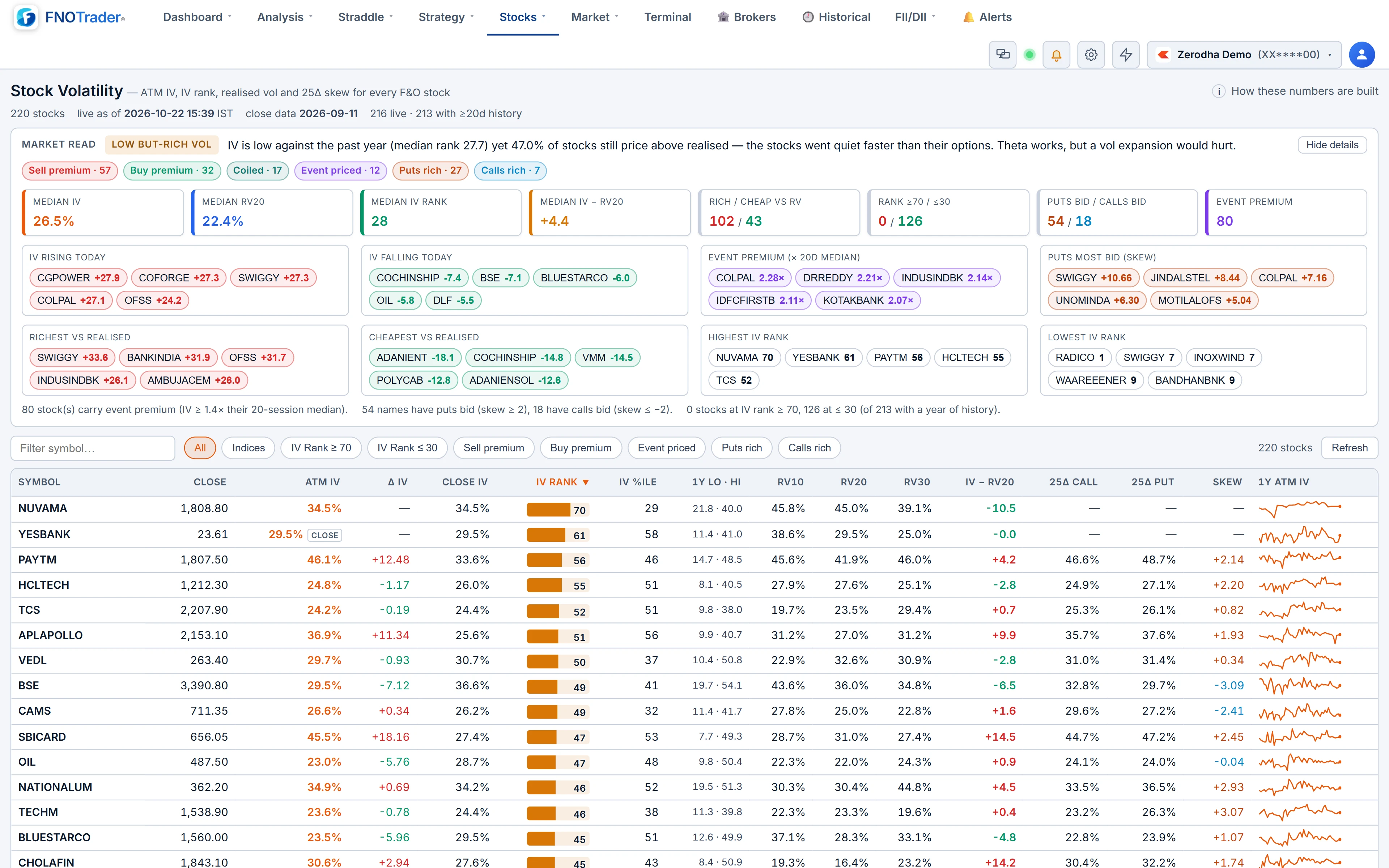
A raw IV number alone tells you little. 30% is high for NIFTY and ordinary for a volatile mid-cap. Two measures compare IV with the name's own history:
- IV percentile: the share of past sessions (FNOTrader uses the last 252) on which IV was lower than today.
- IV rank: where today's IV sits between its 52-week low (0) and high (100).
They differ when IV had one extreme spike. A single spike stretches the range and pulls IV rank down, while IV percentile barely changes.
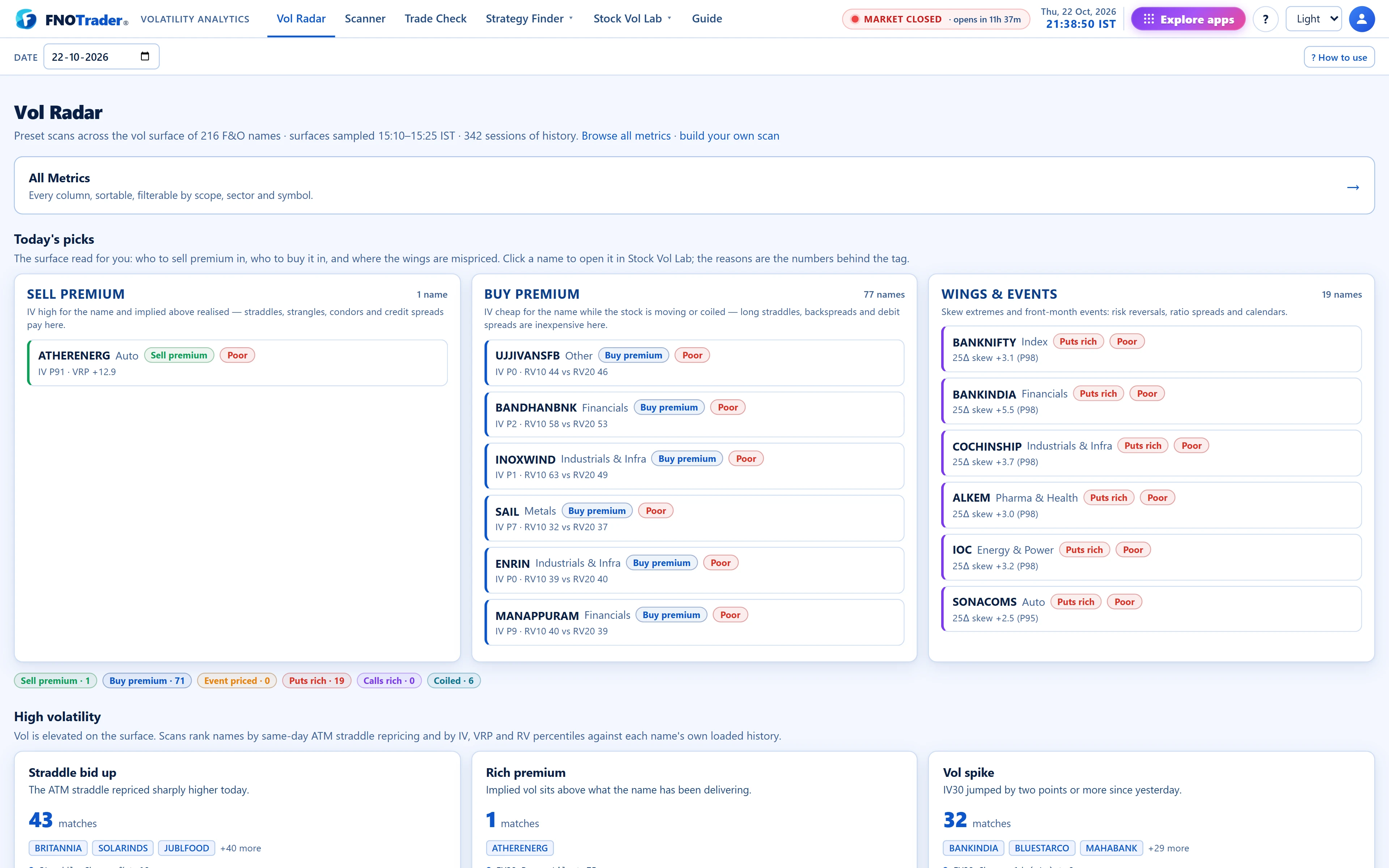
In FNOTrader's Volatility Analytics app, Vol Radar flags names where the extra IV sits in the front expiry. Its Event priced tag needs IV30 at least 1.5 points above IV90 and IV percentile at 50 or above. That pattern usually means a known event falls inside the near expiry. See Vol Radar's rules and IV percentile and VRP for a single name.
How do I model IV crush before I trade?
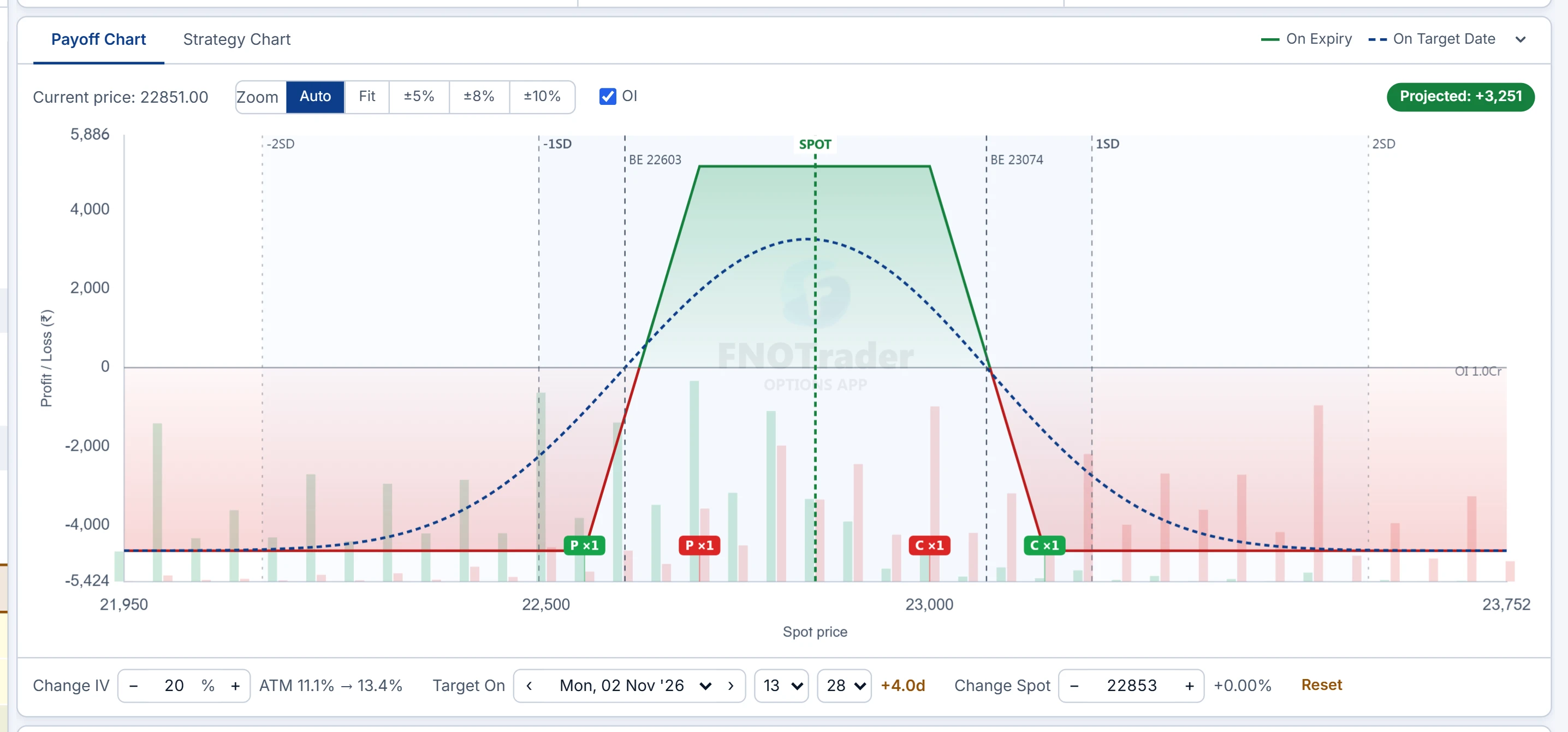
Re-price the position with a lower IV before you take it. In FNOTrader's Option Strategy Builder, the what-if row has Change IV, a relative shift applied to every leg's IV. Target On moves the valuation date to the day after the event. Lower IV, move the date one day forward, and the dashed payoff curve shows what the position is worth after the crush. The Strikewise IVs card lets you change individual strikes when you expect skew to move as well.
The same tool works in reverse for sellers. An IV spike on a short strangle or iron condor shows the mark-to-market hit you would carry before any time decay helps.
Does India VIX affect option premiums?
India VIX is calculated from NIFTY option prices, so it reflects NIFTY option IV rather than causing it. When India VIX rises, NIFTY option premiums are richer across strikes. When it falls after an event, NIFTY options go through the index-level version of IV crush. India VIX often rises into the Budget or an election result, because the contracts being priced expire after the event. For more on this, see VIX and India VIX.
Try it in Volatility Analytics
See IV percentile, Event-priced names and the term structure in Volatility Analytics, and re-price a position for an IV drop in the Options Analytics Strategy Builder.
Educational content. Not a recommendation to buy or sell any security. Options trading involves substantial risk of loss.
Common questions
What is IV crush in simple words?
The fall in option prices that happens when implied volatility drops after an expected event, such as results, is over.
Does IV crush affect option sellers?
In their favour. A short option gains roughly vega × the IV drop. The risk for a seller is the opposite case: the event produces a move bigger than the premium implied.
How long does IV crush take?
For scheduled events it usually happens at or soon after the first open following the announcement. How much IV falls varies by stock and event.
Is high IV good for option buyers?
High IV means buyers pay more for the same movement, and a later drop in IV works against them. Whether the price is worth paying depends on how big a move you expect compared with what the premium implies.
What is the difference between IV rank and IV percentile?
IV percentile is the share of past sessions with lower IV than today. IV rank is today's position between the 52-week low and high. A single spike distorts IV rank much more than IV percentile.
Can I avoid IV crush?
You cannot avoid it while holding a long option through an event. You can measure it in advance: price the position at a lower IV and a later date before you enter.
More on Volatility Analytics
More in Volatility Analytics · App: Volatility Analytics · Definitions: glossary · All: every article