Labels are descriptions, not forecasts
Every label on this page describes the part of the session that has already traded. A day labelled Trend at 11:30 can be a Normal Variation by the close.
The building blocks — letters, POC, value area, IB — are covered in TPO, value area and IB.
Open type: Drive, Reject, Auction
The page looks at the first 15 minutes of the session (on a 30-minute chart, the first bar) and the previous day's value area:
- Drive — the first 15 minutes cover more than half of the eventual initial-balance range. The market moved decisively from the open.
- Reject — the session opened outside the previous day's value area and the first 15 minutes closed back inside it.
- Auction — neither; the open rotated within a range.
Profile shapes
The shape is read from where the TPO letters sit within the day's range:
| Shape | Rule |
|---|---|
| P | The top 40% of price rows hold more than 55% of the letters and the bottom 40% less than 30%; the day closed at or above the POC; and either the top cluster printed later in the day or the day opened in the lower part of the range. Often called short covering. |
| b | The mirror: fat bottom, thin top, close at or below the POC. Often called long liquidation. |
| B (double distribution) | Two balance areas separated by a band of single prints at least two rows wide, with at least 25% of the letters on each side. |
| I (trend / elongated) | At least five brackets, a short POC column relative to the number of brackets, and value spread across most of the range — price moved through levels without dwelling. |
| D | Balanced, or a P/b candidate that failed its close or timing check. |
The close and timing checks exist because a fat top on its own is ambiguous: it can be short covering that held, or a top that later broke down.
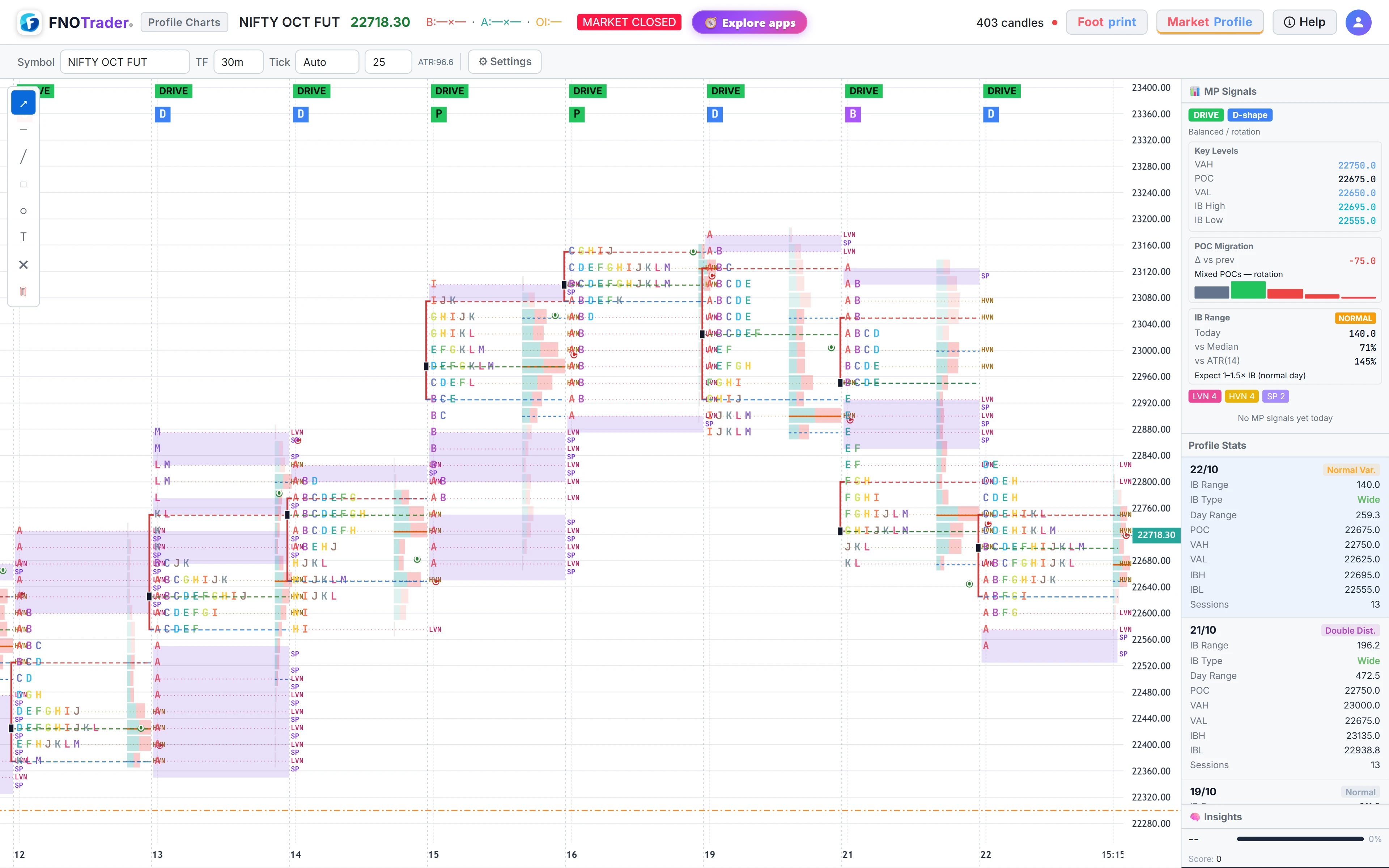
Day types and IB extension
Each day's stats card carries a day type, decided by how far the range extended beyond the initial balance (an extension counts once it exceeds 10% of the IB, or one tick) and where the day closed:
| Day type | Rule |
|---|---|
| Non-Trend | No meaningful extension either side of the IB. |
| Normal | One-sided extension, range up to 1.5× the IB. |
| Normal Var. | One-sided extension, range above 1.5× the IB without a Trend close. |
| Trend | One-sided, range above 2× the IB, and the close in the outer 30% of the range on the extension side. |
| Double Dist. | Range above 1.5× the IB and a single-print separation between two distributions. |
| Neutral / Neutral Ext. | Extension on both sides; Neutral Ext. if the close is in the top or bottom 25% of the range. |
Single prints, LVN and HVN
- Single prints — rows with exactly one letter. Price passed through once and never came back in another bracket.
- HVN (high-volume node) — a row whose volume is more than half a standard deviation above the day's average row.
- LVN (low-volume node) — a row more than 0.3 standard deviations below average and under a quarter of the POC's volume.
These overlays, along with open type and shape badges, sit under the Signals dropdown and are off by default to keep the first view clean.
A worked example
Hypothetical session: IB 24,300–24,380 (80 points). The day's high is 24,560 and low 24,295, a range of 265 points, and it closes at 24,540.
Extension down is only 5 points, below 10% of the IB (8 points), so it does not count. Extension up is 180 points — one-sided. Range 265 is more than 2 × 80 = 160. Close position = (24,540 − 24,295) ÷ 265 = 0.92, in the top 30%. Assuming no single-print band splits the profile into two, the day type is Trend. Had the close been 24,450 (position 0.58), it would be Normal Var. instead.
Where to find it
- Open Market & Volume Profile.
- Each day's day type and IB class appear in the stats beside the chart.
- Open the Signals dropdown and tick LVN, HVN, SP, OT and P/b/D to draw them on the profile.
Related: merging, splitting and MP signals.
Common questions
What is a P-shaped market profile?
A profile whose letters bunch at the top of the range with a thin tail below. FNOTrader also requires the close at or above the POC and a late-printing top cluster or a low open before calling it P.
What is an open drive in Market Profile?
An open where the first 15 minutes cover more than half the eventual initial-balance range, showing a decisive move from the open.
What is a double distribution day?
A day with two separate balance areas joined by a band of single prints, with a meaningful share of letters on each side.
What are single prints?
Price rows that carry only one TPO letter. The market traded there during one half-hour bracket and did not return later in the day.
How does FNOTrader decide a Trend day?
The range must extend on one side of the IB, exceed twice the IB range, and close in the outer 30% of the range on the extension side.
More on Footprint & Market Profile
More in Footprint & Market Profile · App: Market & Volume Profile · Definitions: glossary · All: every article