What the two screens do
Stock to Funds is a reverse lookup: type a company and see every scheme that holds it. Top Stocks turns the whole fund universe's disclosures into a ranked list of the companies funds own most widely.
Two questions come up most often. "Which managers back this company?" — useful context, though not a reason to buy. And "if I already own this stock directly, which of my funds is doubling me up?" — often the more practical one.
Stock to Funds: the reverse lookup
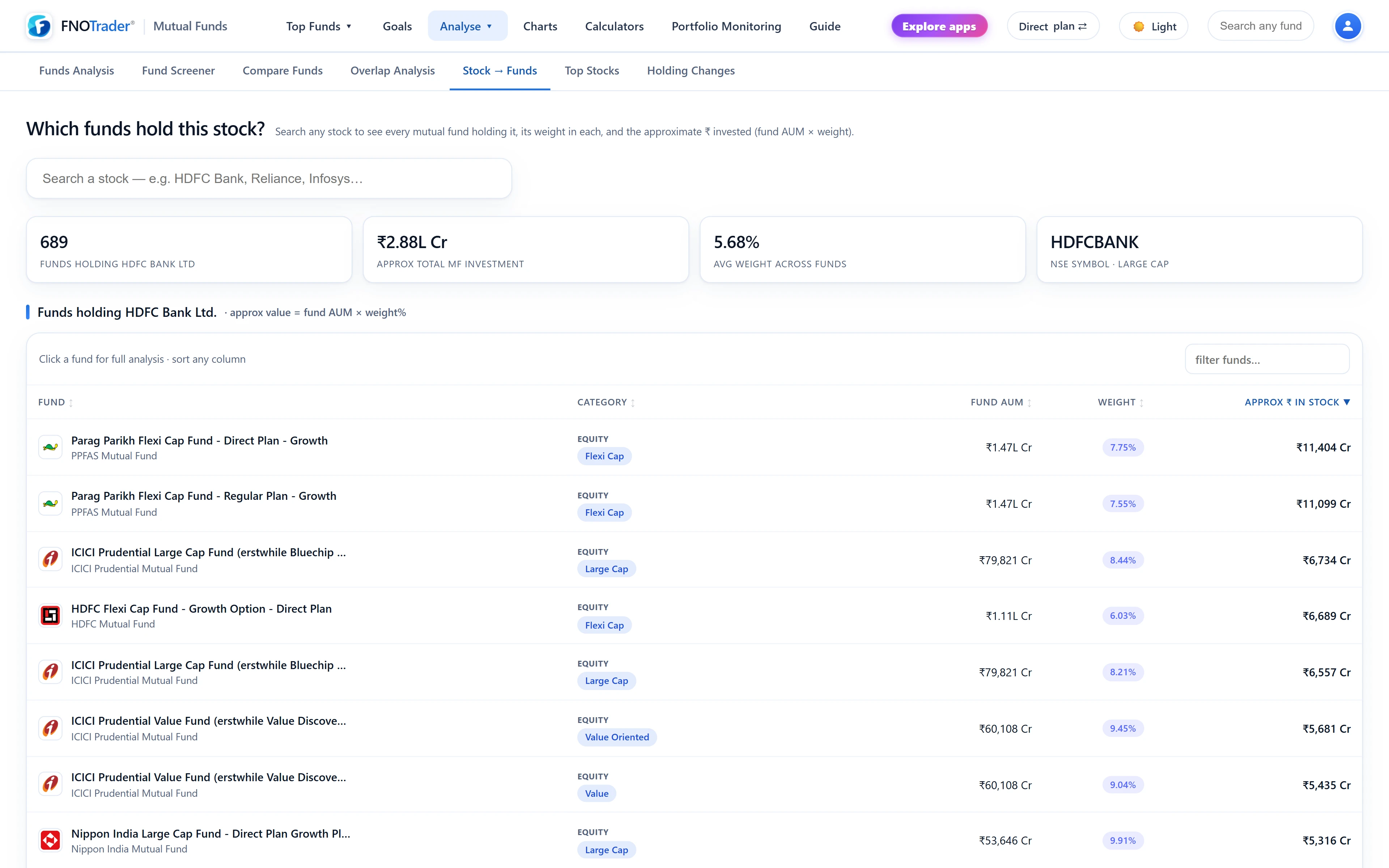
Search by company name or NSE symbol. The search understands brand names that differ from the listed entity funds disclose: Paytm resolves to One 97 Communications, Zomato to Eternal, Nykaa to FSN E-Commerce, Policybazaar to PB Fintech, and a few others.
For the chosen stock the page shows each holding scheme with its fund house, category, AUM, its weight in the stock, and an approximate rupee value. Totals at the top give the number of schemes, the total value and the average weight. The list is sorted by rupee value.
How the value is estimated. Value = the scheme's AUM × its weight in the stock. A hypothetical fund with ₹12,000 crore of AUM holding a stock at 2.5% contributes 12,000 × 0.025 = ₹300 crore. It is an approximation: AUM and the disclosure date are not always the same day.
Before you search, the page shows the 60 most widely held listed stocks, each clickable.
Top Stocks: what funds own most widely
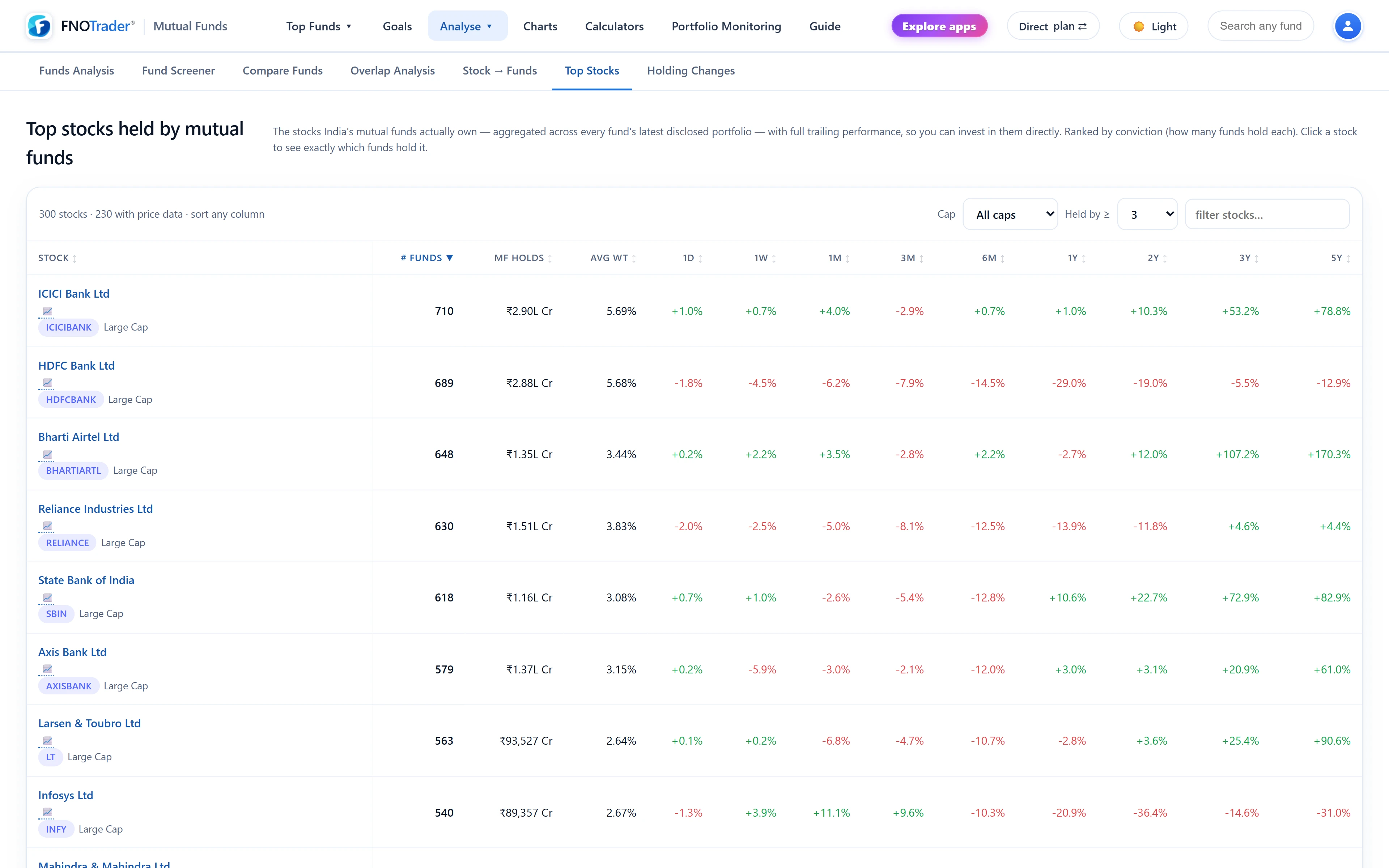
Top Stocks aggregates every fund's latest disclosed portfolio by NSE symbol. For each stock it shows how many schemes hold it, the total rupee value (each scheme's AUM × weight, summed), the average weight across holders, the market-cap class, and the stock's own returns from 1D to 5Y.
| Setting | What it changes |
|---|---|
| Cap filter | All, Large Cap, Mid Cap or Small Cap, by AMFI classification |
| Minimum funds | Default 3; raise it to 5, 10 or 20 for broad conviction, or set any |
| Sort | Number of funds by default (breadth), or value (where the money is), or any return column |
Only genuine long positions count. Arbitrage and hedged funds disclose their short futures legs as negative weights; those are excluded, as are unlisted companies and cash, repo or derivative lines, by requiring a resolvable NSE symbol.
How to read breadth versus value
Breadth and value tell different stories. A large bank held by most equity schemes at modest weights tops both lists. A mid-cap held by 40 schemes at small weights ranks high on breadth but low on value. A stock held by a handful of very large funds can rank the other way. When average weight is high but holder count is low, a few managers have strong conviction; when holder count is high but average weight is low, many hold it as a benchmark position.
For month-to-month buying and selling, rather than the current snapshot, see Holding Changes.
Limits
- Monthly snapshots. Portfolios are disclosed monthly, about ten days after month-end. Positions can change in between.
- Plans share a portfolio. Direct and Regular plans of one scheme hold the same stocks; read holder counts with that in mind.
- Fund ownership is not a rating. Widely held stocks can fall as a group. Read stock screening for analysing the company itself.
Where to find them
- In Mutual Funds, open Analyse → Stock → Funds and type a company or symbol.
- Open Analyse → Top Stocks for the ranked list; set the cap filter and minimum funds.
- Click any scheme to open its page, or check it against your own funds with Overlap Analysis.
Common questions
How do I find which mutual funds hold a particular stock?
Use Stock to Funds in FNOTrader Mutual Funds. Type the company name, brand or NSE symbol to see every scheme holding it, with weight and approximate rupee value.
Why does searching Zomato show Eternal?
Fund disclosures use the listed company's legal name. The search maps common brand names, such as Zomato, Paytm and Nykaa, to the names funds actually disclose.
How is the rupee value of a fund's holding calculated?
It is the scheme's AUM multiplied by its disclosed weight in the stock, so it is an approximation.
What are the most widely held stocks by mutual funds?
Top Stocks ranks them live from the latest disclosures, by number of holding schemes or by total value, with large, mid and small-cap filters.
More on Mutual Funds
More in Mutual Funds · App: Mutual Funds · Definitions: glossary · All: every article