What does SEBI's retail algo framework regulate?
SEBI's circular "Safer participation of retail investors in algorithmic trading" (4 February 2025) did not ban anything. It made retail algo trading traceable:
- Your broker is the principal. Brokers are responsible for every algo order that goes through their API. Algo platforms act as their agents and have to be empanelled with the exchanges.
- No open APIs. API access needs a vendor- and client-specific API key, OAuth-based login with two-factor authentication, and a whitelisted static IP.
- Every algo order is tagged. Orders carry a unique identifier issued by the exchange, which creates an audit trail. The exchange can stop a specific algo ID with a kill switch.
- Family use only. An algo you write yourself can be used for your own family (self, spouse, dependent children, dependent parents), but not offered to other investors.
The timeline moved twice. The framework was due on 1 August 2025, was pushed to 1 October 2025, and a 30 September 2025 circular made it fully applicable to all brokers from 1 April 2026.
Do I need a static IP for algo trading?
Yes, if your orders go through a broker API. The broker whitelists one address and refuses API orders that come from anywhere else. Under the framework you can change that address at most once per calendar week.
This catches people out because the check is on the address the order came from, not on your password. A platform that runs your stop-losses and algos on its servers sends orders from its server, not from your laptop. That is why an account can log in and stream prices but still have its orders refused. We explain the mechanics in Static IP for API trading.
On FNOTrader, orders are sent server-side, so stops and algos keep running with your laptop closed. FNOTrader can also give you a dedicated static IP, so the address your broker sees is registered to you.
What is the 10 orders-per-second rule?
Under NSE's implementation standards, an algo you build yourself has to be registered through your broker only if it sends more than 10 orders per second. Below that it does not need registration. It still needs the static IP, and its orders still carry an algo identifier.
For context, most retail option strategies place a handful of orders per minute: entries, stop-losses, adjustments. The threshold is aimed at high-frequency behaviour, not at a four-leg iron condor.
What is the difference between white box and black box algos?
- White box (execution) algos: the logic is disclosed and you can replicate it. A strategy you configure yourself, with rules you can read, falls here.
- Black box algos: you cannot see or replicate the logic. A provider selling one has to register as a SEBI Research Analyst and keep a research report for each algo. A change in logic means registering a new algo.
This is why "buy our algo, 3% a month" offers deserve suspicion. A provider selling hidden logic as a product has regulatory obligations, and no registration permits promising returns.
Is algo trading safe in India?
The framework makes it traceable, not risk-free. An algo can lose money faster than a manual trader, because it does exactly what it was told even when conditions change. Most avoidable algo losses come from a small set of causes:
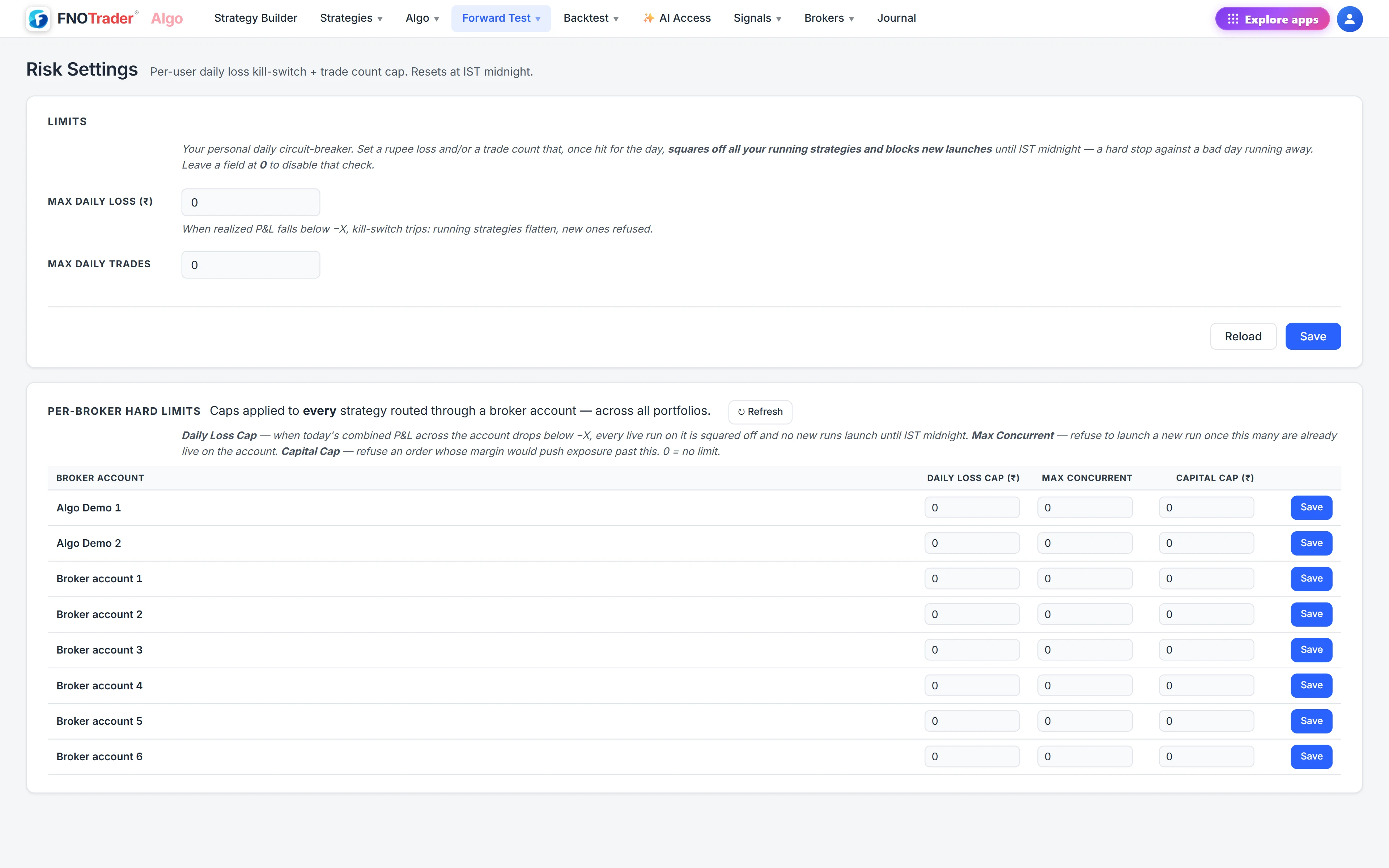
- No daily loss limit. A kill switch on account MTM stops a bad day from becoming a disastrous one. See daily loss kill switch.
- Market orders on thin strikes. Protective limit orders cap the fill price.
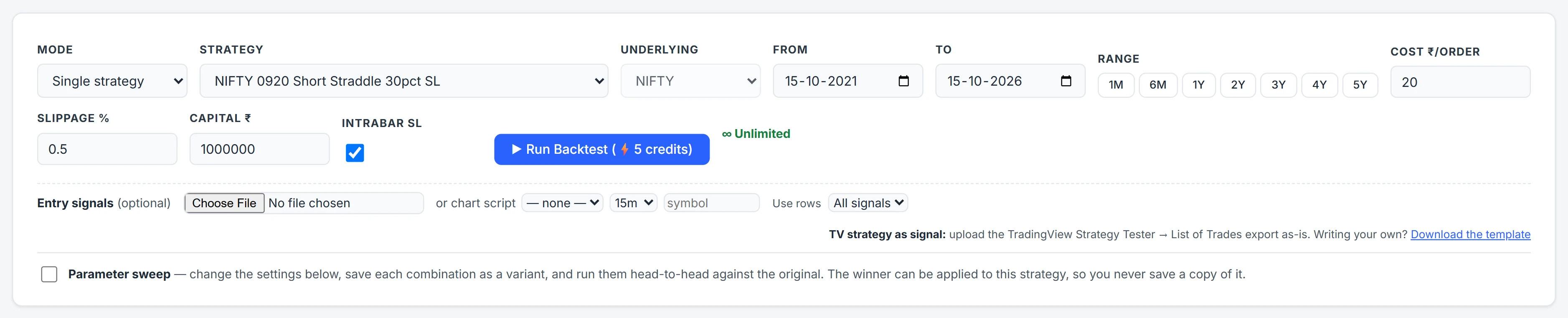
- Strategies never tested on history. A backtest with realistic costs and slippage shows what a rule did across years, not just on the weeks you remember. See running an options backtest.
- Going live without a forward test. Paper trading on live prices catches the differences between backtest and reality. See forward testing.
How do I start algo trading in India?
- Open or use an account with a SEBI-registered broker that offers API access. Connect it to the platform you will use.
- Register a static IP with the broker. You can use your own or the platform's dedicated one.
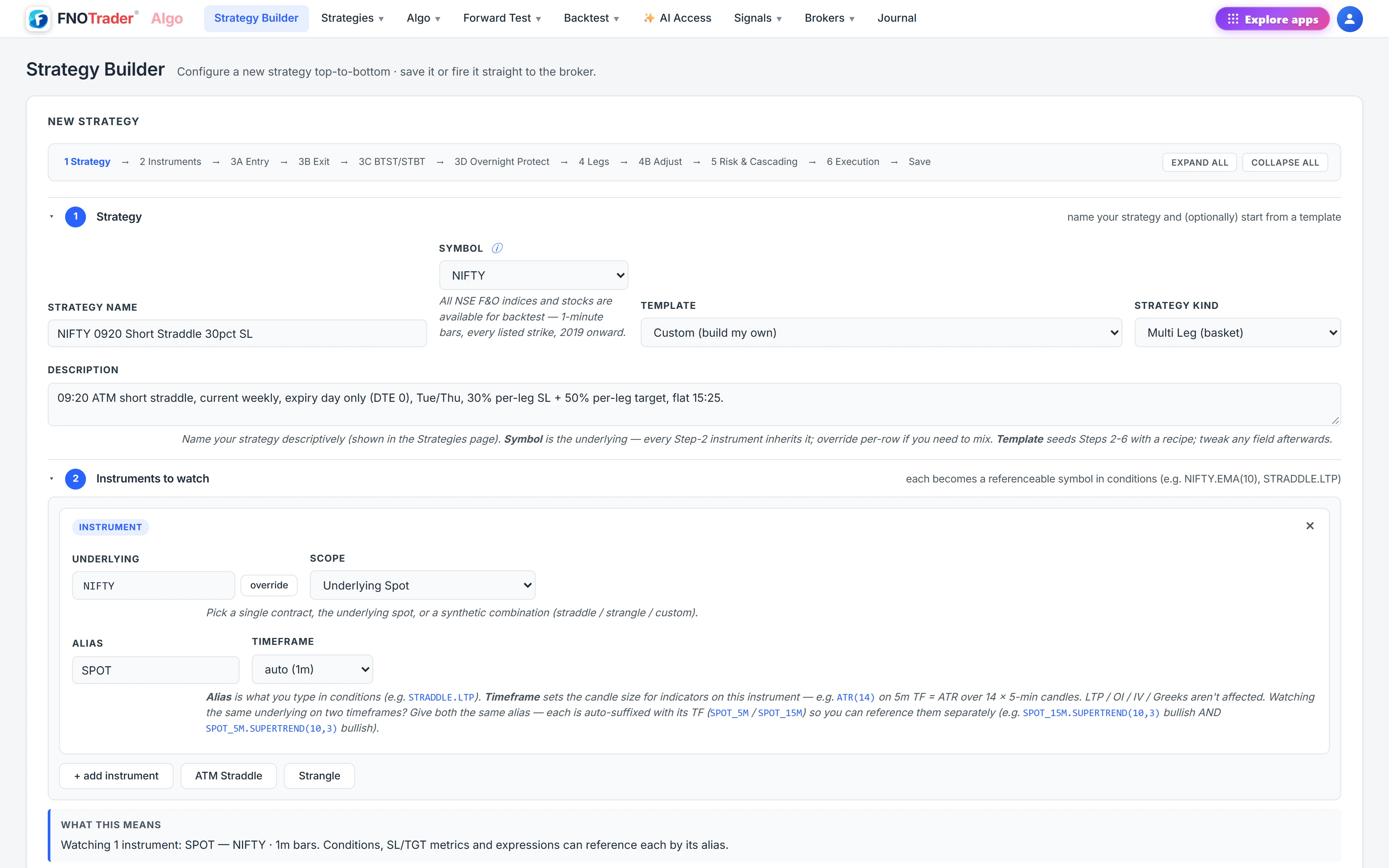
- Write the rules down before you code or configure anything: entry, exit, stop, position size, and what happens on a gap or a holiday.
- Backtest those rules over several years with costs included.
- Forward-test on paper for a few weeks.
- Go live small, with a daily loss cap switched on.
FNOTrader's Algo & Backtest app covers steps 3 to 6 without code. It has a no-code strategy builder, options backtests with costs and slippage, paper forward tests on live prices, and live deployment to your own broker account with per-leg and basket-level risk settings. It is software that places orders you define into your own account. FNOTrader is not a SEBI-registered adviser and offers no strategies, tips or return expectations.
Try it in Algo & Backtest
Build the rules, backtest them with costs, forward-test on paper, then run them on your own broker account in Algo & Backtest.
Sources: SEBI circular SEBI/HO/MIRSD/MIRSD-PoD/P/CIR/2025/0000013 (4 Feb 2025); SEBI circular SEBI/HO/MIRSD/MIRSD-PoD/P/CIR/2025/132 (30 Sep 2025); NSE implementation standards (5 May 2025); SEBI study on individual traders in equity derivatives, FY25 (July 2025). This article explains regulation; it is not legal or investment advice.
Common questions
Is algo trading legal in India for retail traders?
Yes. Retail traders can run algos through a SEBI-registered broker's API under SEBI's retail algo framework, which applies to all brokers from 1 April 2026.
Is algo trading illegal without a static IP?
It is not illegal, but your broker will refuse API orders that do not come from your whitelisted static IP. In practice, no static IP means no API orders.
Do I need to register my algo with SEBI?
Not with SEBI directly. A self-built algo has to be registered through your broker only if it exceeds 10 orders per second. Black box algo providers have to register as Research Analysts.
Can I share my algo with friends?
A self-developed algo can be used for your family (self, spouse, dependent children and dependent parents), not by other investors.
Is algo trading profitable in India?
No rule makes an algo profitable. SEBI's own study found about 91% of individual F&O traders made net losses in FY25. Automation removes hesitation and manual errors, but it does not create an edge. Test any rule on history and on paper before risking money.
Does an algo platform need SEBI registration?
Algo providers are not directly registered with SEBI. They have to be empanelled with the exchanges, and brokers can work only with empanelled providers. Black box providers additionally need Research Analyst registration.
More on Algo & Backtesting
More in Algo & Backtesting · App: Algo & Backtest · Definitions: glossary · All: every article