What is gamma in options?
Delta is how much an option's premium moves per point of the underlying. Gamma is how much the delta itself changes per point. Gamma is highest at the money and rises sharply as expiry approaches. A far OTM option early in the week has a tiny delta, and its delta barely changes. The same strike on expiry afternoon, once the index comes close to it, can see its delta go from 0.05 to 0.5 within a few dozen points.
Why does it happen on expiry day?
With hours left, time value is almost gone, so OTM strikes trade at a few rupees. Their price is mostly the market's estimate of the small chance they finish in the money. If the index moves quickly towards a strike:
- Its delta jumps because of very high gamma, so each further point adds more premium than the one before.
- Sellers of that strike may buy back or hedge. That can add to the move, but it is not guaranteed.
- The option's percentage move dwarfs the index move, because it started from almost nothing.
The same mechanism works in reverse. Most cheap OTM options bought on expiry day simply go to zero.
A worked example
Hypothetical numbers for illustration. At 13:30 on expiry day NIFTY is at 24,000. The 24,150 CE trades at ₹3 with a delta near 0.08.
By 15:00 NIFTY has rallied to 24,180. The 24,150 CE is now ₹30 in the money and trades at about ₹38.
- The index moved 0.75%.
- The option went from ₹3 to ₹38, about 12.7×.
Delta did not stay at 0.08. Rising gamma pushed it towards 1 as the strike went in the money, so later points were worth far more than early ones. If NIFTY had stalled at 24,100, the option would most likely have expired at zero.
How is gamma exposure (GEX) related?
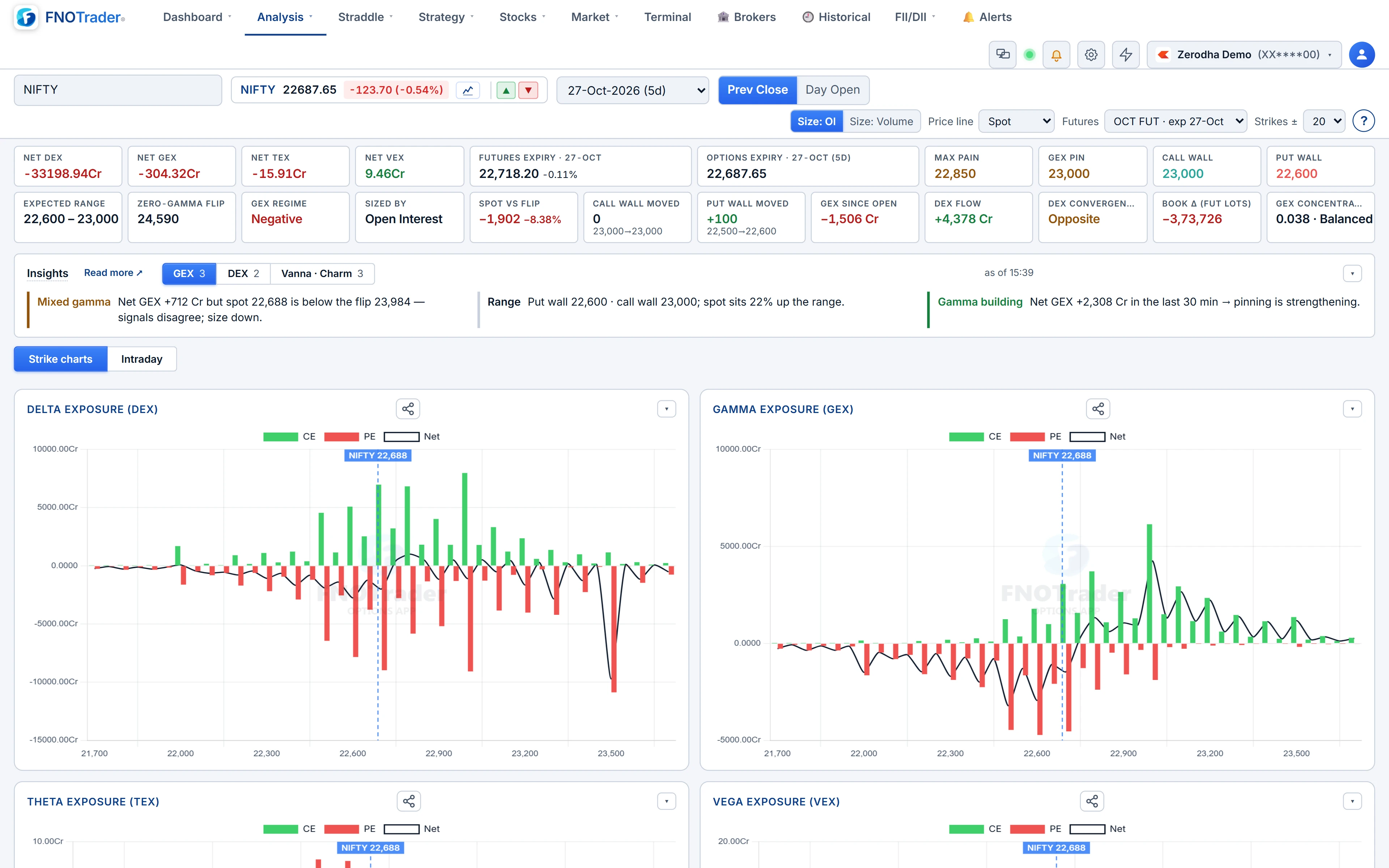
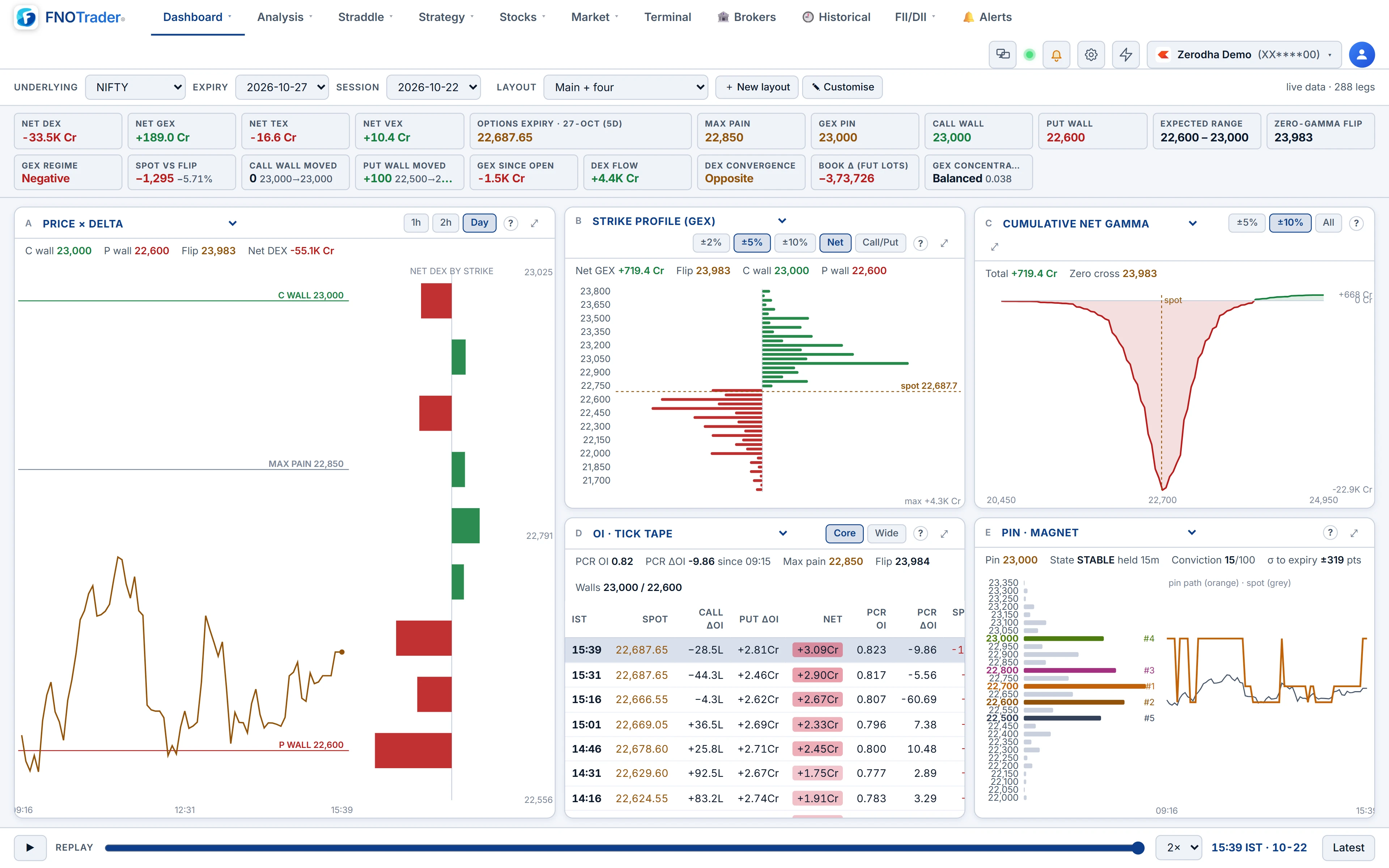
GEX adds up gamma across the whole option chain, weighted by open interest. It is a way to describe where hedging flows might push or damp moves, if option writers hold the other side of the book, which is broadly true for index options but not observed directly. FNOTrader's Greeks Exposure page shows:
- the zero-gamma flip, where the running sum of GEX crosses zero near spot;
- the call wall and put wall, the strikes with the largest call and put gamma × OI;
- the GEX pin, the strike with the most combined gamma × OI.
Above the flip with positive net GEX, implied hedging leans against moves. Below it with negative net GEX, implied hedging adds to them. These describe positioning, not a signal. The method and its limits are covered in Gamma Exposure (GEX) for NIFTY.
Is there a "gamma blast strategy"?
Courses and social media sell "gamma blast strategies", usually buying far OTM options late on expiry day. Keep three facts in mind:
- Most of those options expire worthless. A 12× winner has to pay for many small losers.
- Stops behave badly at ₹2–₹5 premiums. A percentage stop is inside the bid-ask spread, and fills on thin strikes can be well beyond the trigger price.
- Memory is biased towards the blasts. The expiries where nothing happened are rarely posted.
Whether any such rule has worked is a question for data, not anecdotes.
How do I study gamma blasts on past data?
- Replay the session. The Options Simulator replays any past NIFTY session minute by minute, so you can watch OTM premiums through an expiry afternoon. Historical mode opens expired option chains at any minute.
- Replay positioning. The GEX Intraday tab rebuilds net GEX, the flip and the walls for a recent date.
- Test the rule on every expiry, not the famous ones. In Algo & Backtest, a DTE filter runs a strategy on expiry days only, with costs and slippage included, so you see the whole distribution, including the expiries that did nothing.

Try it in Options Analytics
Watch the zero-gamma flip, call and put walls and the GEX pin live, or replay a past expiry, in Options Analytics; test expiry-day rules on every expiry in Algo & Backtest.
Educational content. Not a recommendation to buy or sell any security. Options trading involves substantial risk of loss.
Common questions
What is gamma blast in options?
Traders' term for an expiry-day move in which cheap OTM options multiply in value within minutes, because gamma is extreme near the money close to expiry.
Is gamma blast real or a myth?
The mechanism is real: gamma does peak near expiry. The frequency is what is exaggerated. Most expiries do not produce one, and they cannot be reliably predicted in advance.
Which day does gamma blast happen?
It refers to expiry day, usually the final hours. NIFTY and SENSEX have weekly expiries on exchange-set weekdays. Check the current calendar, because the weekdays have changed more than once.
What is the difference between gamma blast and short covering?
Short covering is writers buying back positions, which shows as rising price with falling open interest. It can be part of a gamma blast but also happens on ordinary days.
What is a GEX level?
A strike or price derived from gamma exposure, such as the zero-gamma flip, a call or put wall, or the GEX pin. These describe where option positioning is concentrated.
More on Options App
More in Options App · App: Options Analytics · Definitions: glossary · All: every article